The Hallie Ford Museum of Art
The Hallie Ford Museum of Art, established in 1998, is a key resource for Art studies at Willamette University. The museum contains six exhibition galleries and a state-of-the-art Art History classroom. Four of the galleries present works from the University’s extensive permanent collections of American, Native American, European, and Asian art, while two are devoted to changing exhibitions of extraordinary quality that often come from major collections beyond Willamette. In recent years, these have included shows of Egyptian art borrowed from a variety of American collections and ancient Roman art from the Boston Museum of Fine Arts.
In addition, the Pacific Northwest Art and Artists Archive (PNAAA) resides at Willamette University's Hatfield Library, and is an excellent resource for archival research projects by students. The PNAAA is a collection of artists' letters, exhibition catalogues, news clippings, and other materials related to their careers in the Pacific Northwest. Artists represented in the PNAAA include the following individuals among others: Glen Alps, Constance Fowler, Ruth Grover, Carl Hall, Charles Heaney, Betty LaDuke, Jack McLarty, C.S. Price, Mark Sponenburgh, and Jan Zach.
The Hallie Ford Museum, a beautifully redesigned International Style building originally constructed in the 1960s, is a calm retreat for contemplation and study. Works in the collection and changing exhibitions are the subjects of course assignments as well as advanced independent research by students. Those interested in the possibility of careers in museum work can work as interns with professional staff members for a semester or longer.
The annual Art History Senior Dinner is held in the museum's elegant lobby each April.
-
Though the Hallie Ford Museum of Art has many gems in its permanent collection, George Johanson’s 1982 Black Cat-Mountain is particularly notable to me because of the evolution of my rapport with it over time. During my four years as an undergraduate student, this large work executed in acrylic and oil on canvas has hung in the same spot in the Pacific Northwest galleries of the Hallie Ford Museum of Art.
The sizable, predominately rose-hued painting attracted particular attention on my very first visit to the museum as a freshman.
The aesthetic appeal was most likely due to the attractive silhouette of a black cat leaping across the center of the composition. I, as many do, happen to love cats. Untrained in the art of looking, I found this painting to be yet still a striking arrangement of form and color. A recognizable urban landscape supports the looming form of mountain and spewing smoke, a representation of the 1980 eruption of Mt. St. Helens, as noted on the placard accompanying the work.
With figurative forms, here was a painting that could be read, and entered into, one that opened itself up in an enigmatic yet accessible manner.
Soon after delving into the curriculum of Art History, details of the work of art emerged further to be contemplated. A curious composition, the silhouette of the black cat obscures the face of the representation of a seated figure. The pharaoh-like pose and drapery are the only seeming stillness in the composition, in which an interior space inter-penetrates an exterior space. The eruption of the volcano over the city-scape, one that rained smoke and ash down over the urban sprawl of Portland, leads to the contemplation of the predominance of nature over urban stability and comforts.
The magnitude of the chromatic composition is unerringly vibrant, evoking an impression of space with imagined color and flattened imagery.
Carefully structured forms of chaos delineate the expression of the ordered chaos of the natural world, as egg-like forms balance on the depiction of the interior space. Not only is the representation of the egg a nod towards the precariousness of our way of life at the mercy of the natural world’s unpredictability, but it can also be a modern gesture of appropriation, in which the form of an egg bears a direct reference to Renaissance-era symbolism.
Alongside contemporaries dealing with the geography of the Pacific Northwest in the Hallie Ford’s northwest collection, this larger, brighter composition moves towards a more artificial aesthetic in that the imitation of natural forms extends towards a personalized impression of interior space and landscape. Historical record and imagined reality, this painting expresses a set of visual codes rife with meaning and more delicate nuances.
This painting attests, more personally, to a wealth of knowledge gleaned with time spent exploring and revisiting objects such as this painting in our university’s museum, and demystifying, for at least one student, what it means for art to be art in its every context.
-Lauren Johnson, Fall 2013
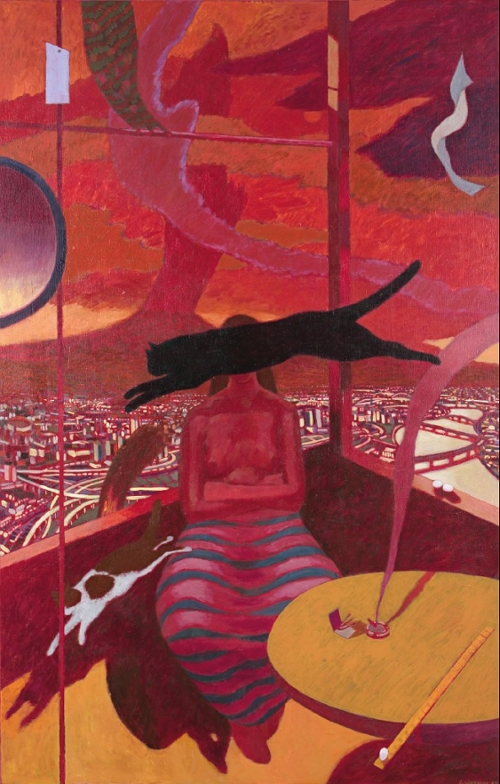
George Johanson (b. 1928), Black Cat - Mountain, 1982, Acrylic and oil on canvas, 68" x 44", " Collection of Hallie Ford Museum of Art, Maribeth Collins Art Acquisition Fund, Gift of George Johanson
Art History Honors:
- Recipient of Willamette University Department of Art History Honors; The Erwin Panofsky Research Award
-
While I was an intern at the Hallie Ford Museum of Art during my senior year at Willamette, I spent a great deal of time working with the museum’s permanent collection.
The consideration the museum has for Pacific Northwest artists – particularly those underrepresented in major Northwest museums – is evident by their many significant regional acquisitions. Many of my favorite works in the museum are part of their Northwest collection, and one I am especially fond of is Carl Hall’s oil painting, Wailing Wall, of 1954.
Carl Hall is a Northwest landscapist and my favorite of the artists represented in the HFMA’s Northwest collection.
Of all his works that the museum owns, Wailing Wall stands out to me because of its stark, symbolic connotations and my own love of the Oregon Coast. In this depiction of the Oregon Coast, Carl Hall displays sensitivity to the atmosphere of the setting – particularly the duality of grey, muted moodiness, and monumental splendor that characterizes the coastal environment.
A dead bird in the foreground melts into a mosaic of shadow and light, rigidity and fluidity, organicity and inorganicity that subsume the physical elements of the artwork; the bird, beach, seawall, and beyond that, the glassy ocean and sky of soft, columnal clouds.
To me, the painting appears fundamentally unified by contrast within its respective elements, and through that quality, is a very genuine symbolic interpretation of the Oregon Coast.
— Patrick Newhall, Fall 2013
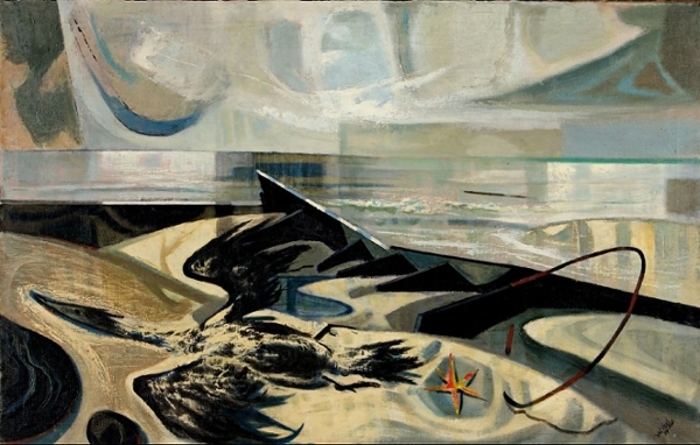
Carl Hall (1921-1996), Wailing Wall, 1954, Oil on Canvas, 28.25" x 44," Collection of Hallie Ford Museum of Art, Gift of Maribeth Collins Art Acquisition Fund
Honors and Awards
- Recipient The Roger P. Hull Art Museum Award
-
The purple irises, rising up in simple beauty have always captivated me in this print by Ando Hiroshige.
I fell in love with the technique, mastery, and aesthetic look of Japanese Ukiyo-e woodblock prints in a Japanese Art History class taken during my sophomore year.
That class, along with a Prints Study class, taught me to appreciate the skill, time, and thoughtfulness that went into making woodblock prints. Hiroshige’s Hundred Views of Edo and Hokusai’s print series Thirty-six Views of Mount Fuji contain some of my favorite Ukiyo-e prints.
But this particular print from Hiroshige’s Meisho Edo Hiakke series is exceptional for me. Irises are the main focus in the scene, and they obscure the full view of the background in simple lines and soft curves. This print depicts the gardens of Horikiri but Hiroshige’s method of making this iconographical connection is unique. The gardens themselves are off in the distance, not the focus of the print at all. It is such a clever and unconventional way of depicting a famous place in Edo.
I am equally impressed with Hiroshige’s use of perspective and depth, given that such effects were not commonly utilized in many of the flat, two-dimensional woodblock prints of this time.
What I love most about this print however, is the vantage point. I always feel a sense of calm when looking at this scene, as if I’m sitting amongst the tall irises, looking out over the garden. I have ambitious plans to become a print collector, and this is my most coveted print.
— Virginia Van Dine, Fall 2013
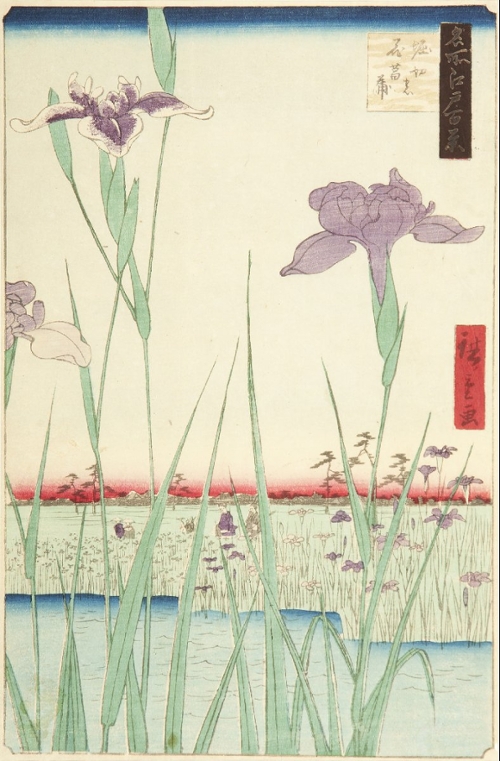
Ando Hiroshige (1797 - 1858), Meisho Edo Hiakkei (Hundred Views of Edo, Famous Places), 1856-1859, Woodblock print, 13.25" x 8.75", Collection of Hallie Ford Museum of Art
Honors and Awards
- Recipient of the The Joy Lorraine Hayhurst Award; Willamette University Department of Art History Honors