This award is supported by generous financial contributions from Susan Torkelson and Steven N. Dulaney '97, M.A.T. '98. Initial funding also came from Dr. John W. Cotton '47.
The Carl S. Knopf award is bestowed annually on the Willamette undergraduate student who has written the best term paper or senior thesis dealing directly with the ancient world or with the reception of ancient cultures worldwide in later time periods.
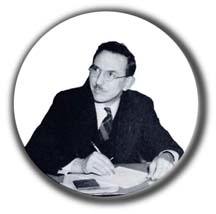
This award is dedicated to the memory of biblical scholar and Assyriologist Carl Sumner Knopf (1889-1942), who served as president of Willamette University from 1941-1942. As a prolific biblical scholar who combined his expertise in theological studies with interests in ancient history, Near Eastern archaeology, and Assyriology, Carl S. Knopf is an excellent example of the interdisciplinary nature of the area of research supported by the Center for Ancient Studies and Archaeology.
The purpose of this award is to honor students who invest extra time and care in researching and writing about a topic that deals directly with the ancient world or with the reception of ancient cultures worldwide in later time periods. The ancient world is understood to include the ancient cultures of the Mediterranean world, but also those of the ancient Near East, Asia, Africa, Oceania, and America. Papers dealing with the reception of such cultures in later time periods might focus on the use and re-contextualization of literary or artistic themes, motifs, and styles inherited from an ancient tradition or, for example, on the contemporary audience response to a new staging of an ancient play.
With this award, the Center seeks not only to reward those students who are already doing superior work in their classes, but also to raise the quality of papers in ancient studies overall. The deadline for the current academic year is: Sunday May 2, 2027. Papers submitted must have been written for a class during the current semester or during the previous calendar year (i.e., spring semester 2024, fall semester 2023, or spring semester 2023). Papers may be submitted by Willamette undergraduate students themselves or, in consultation with the student author, by a faculty member on behalf of that student.
Papers are read anonymously by a small committee of CASA core faculty members selected by the CASA director. Papers are judged with respect to original thinking, excellent writing and research skills, and familiarity with important disciplinary conventions. Winners are encouraged to submit their winning paper to the Willamette University's Student Scholarship Recognition Day in April. The award carries a monetary prize in the amount of $250.
Please email Mary MartinAdministrative Program Coordinator for the Center for Ancient Studies and Archaeology with any questions.
Past Recipients
The Carl S. Knopf Award For Best Student Paper on the Ancient World
Hannah Purdy '24
(CLAS) At the Intersection of Gender and Olympianization in Ancient Myths
Rowan Barton '22
(Archaeology, Classical Studies & Environmental Studies Majors) Manly Women and Womanly Men: An Analysis of Gender Stereotypes and Inversions in Terences Hecyra
Louis Polcin ' 21
(History/Classical Studies) At the Crossroad of Cultures: Josephus’s Portrayals of Three Hasmonean Kings within Genre Contexts and Cultural Literary Models
Kai Griffith '21
(Art History & Classical Studies Major) Art Literature and Theories Relating to Caravaggio’s Ecce Homo
Louis Polcin '21
(History & Classical Studies Major) Across The Timeline: Understanding the Place of the Epic of Gilgamesh and the Iliad Within the Epic Tradition
Louis' paper discusses the different ways in which the AkkadianEpic of Gilgameshand Homer'sIliadportrays their heroes' search for fame and immortality. Gilgamesh journeys to the end of the world to ask the only human ever granted immortality, Uta-napishti, how he could achieve eternal life himself. He ultimately fails at both the tasks set by Uta-napishti, yet he gains immortality in unexpected ways, through the scribally transmitted text of his own story. TheIliad, in turn, as an epic that was originally transmitted orally, conceives Achilles as a bard who manipulates his own story by deciding to face and defeat Hector even though that means his own death. In this way, he manages to establish his own hero cult and to become the object of narratives spread orally by other bards.
Rachel Dell '19
(Biology & Classical Studies Major) Biology is a Science. An Analysis of Lucian's True History as Science Fiction
Rachel Dell's thesis "Biology is a Science. An Analysis of Lucian'sTrue Historyas Science Fiction" contains a genuinely interesting and original argument; it demonstrates an ability to read and comment on the original ancient Greek text, and it shows an ability to incorporate, synthesize, and critique existing scholarly literature in multiple fields (Biology, Classics, and modern literary criticism). It is impressive that she actually contacted contemporary writers of science fiction in order to elicit definitions of the genre by its current practitioners -- this struck the committee as innovative and unusually enterprising. Rachel's paper argues, on the one hand, that Lucian, rather than filling his story with imaginary advanced technology, inverts the practice of modern science fiction writers by replacing contemporary technology, especially metal technology, with natural resources. On the other hand, the paper shows that the many encounters of Lucian's narrator with alien races and his detailed, scientific description of their xenobiology, which modern scholars have largely overlooked, exactly match what we would expect in modern science fiction. Accordingly, Lucian deserves to be called one of the inventors of science fiction, despite several recent attempts to deny him this status. Rachel's paper is well-argued and eloquently written and, we believe, more than deserves the Knopf award.
None of the submitted papers qualified for the award.
Rachael Lew '16
(Archaeology Major) Lost Heritage of Humanity, The Problem of Unprovenanced Artifacts: An Analysis of Pre-Columbian Mexican Spindle Whorls from the Hallie Ford Museum of Art
Lindsey Moriyama '16
(English and Classical Studies Major)
Seneca's Subtle Sarcasm
(analysis of two poems in Seneca's Apocolocynthosis)
Spencer Andrews '16
(Comparative Literature and Classical Studies Major)
Barbarians Can Be Romans Too
Erin Kahn '15
(English Major)
The Gods Know I Had No Choice: The Role of Fate in Sophocles’ Theban Plays
Patrick Leary '11
(Archaeology Major )
The Orange-Brown Patinas on the Parthenon of Athens: Implications for Human-Made Origins
Alicia Maggard '10
(Classical Studies and History Major)
Running on Imperial Time: Augustus and the "Fasti Praenestini"
Alicia's paper illustrates how Augustus left his mark not only on the three Physical dimensions of Rome, but also on Roman time.
Alicia Maggard '10
(Classical Studies and History Major)
The Supposed Separation of Collegium and State: Trajan and the Rise of Mercantile Associations
Winners of the Carl S. Knopf Award
2026
Benjamin McInnis '26 for his Fall 2025 senior thesis " S✟icks and Stonings: What the Crucifixion tells us about Judean Capital Punishment."
2025
Senior Thesis Award:
Cate Hamilton '25
"Faces of Jade: Mesoamerican Greenstone Carvings from the Hallie Ford Museum of Art" (Spring 2025 senior thesis)
Term Paper:
Frances Peterson '27
"What is a good friend to Aristotle? How is friendship important to the virtuous person?"