Student Research
Student research opportunities, both collaborative and independent are infused throughout our curriculum.
All majors will complete two Research Intensive courses centered around one or several research questions for which students will develop hypotheses, collect, analyze, and interpret a data set, and write up their findings. Other opportunities for research include independent study with faculty on a topic of mutual interest and the Honor Thesis. In addition, there are several ways to be involved in research on campus (see below).
The ENVS department has a strong history of and ongoing commitment to externally funded initiatives supporting and advancing faculty and student research (Luce Foundation, American Chemical Society, Oregon Watershed Enhancement Board, Natural Resources Conservation Service, Wiener Foundation, Kress Foundation, American Political Science Association, Association of American Geographers), research and educational facilities (Keck Lab, Murdock Foundation), student scholarships (Dempsey Foundation, Webber), endowed chair and lecture series (Dempsey Foundation), and curriculum development (National Association of Geoscience Teachers).
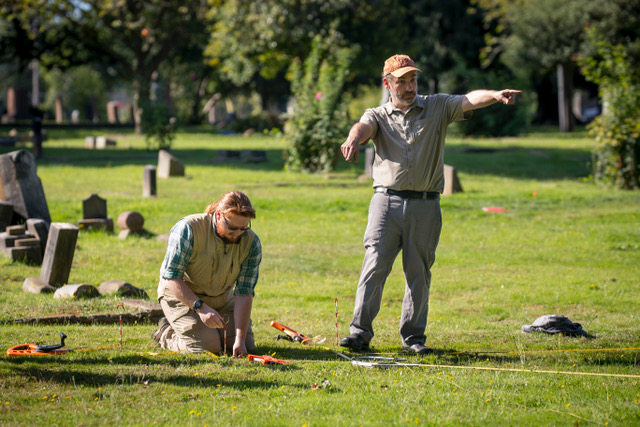
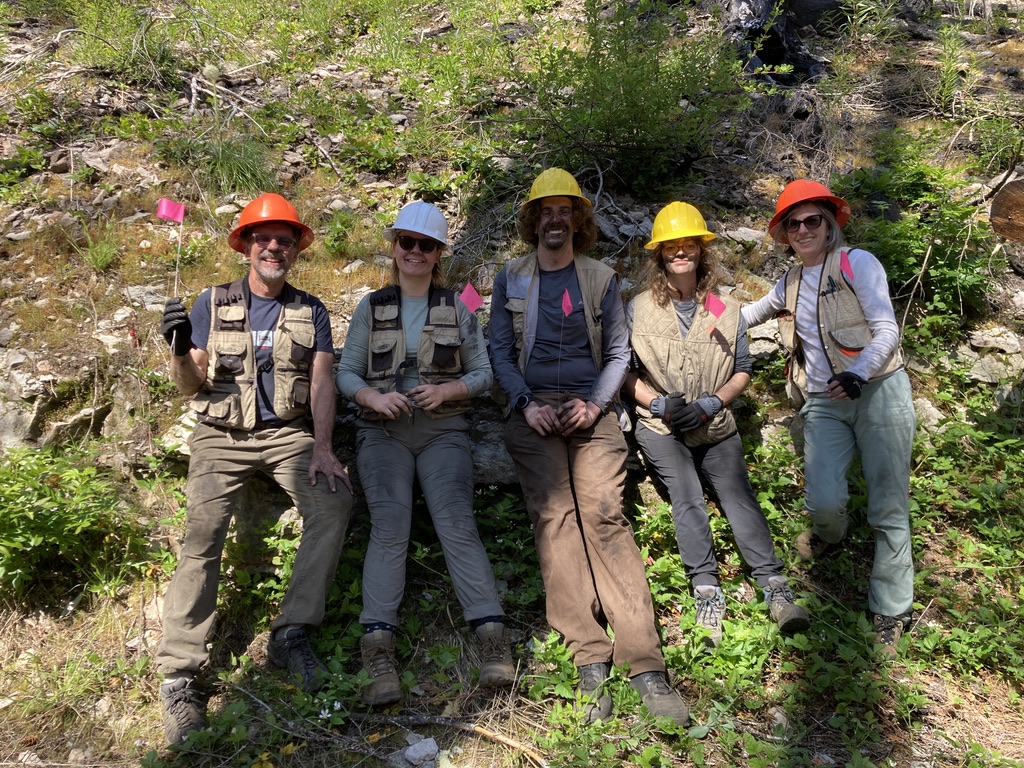
Senior Environmental Science majors have the opportunity to conduct independent research with a faculty mentor. As an Environmental Science honor thesis student you will carry out an independent research project, write a formal thesis, and present your findings in a public forum. Students interested in conducting an honors thesis must apply directly to their prospective thesis advisor.
Adelaide Kemp. 2025. Quantifying Denitrification in Salem Stormwater Control Measures through a Functional Gene Abundance Analysis
Ella Ashford. 2025. Developing Methodologies for Remotely Operated Vehicle Based Photogrammetry to Monitor Coral Reefs in the National Marine Sanctuary of America Samoa.
Brice Hoerauf. 2025. The Role of Financialization in the Evolution of Natural Disaster Insurance and the Perpetuation of Gentrification Within Vulnerable Communities
Caerwyn Nelson. 2024.Beachie Creek before and after: Post-fire vegetation regeneration.
Kirsten Calleja. 2024. Denitrification Potential in Urban Stormwater Control Measures
Isabella Stone. 2024.Filling in the gaps: seedling survival in response to light availability and seed dispersal patterns
Jordan Edner. 2023.Deep Ecology Reimagined: Dissolving Boundaries to Heal Environmental Relations
Isabelle Pfander. 2021. Visualizing Ocean Acidification During the end-Permian Mass Extinction
Arabella Wood. 2020.Turn and Turn: The Practical and Prayerful Dimensions of Regenerative Agriculture
Claire Verstrate. 2020. Exploring the relationship between public opinion and data framing: A case study of Covanta Marion
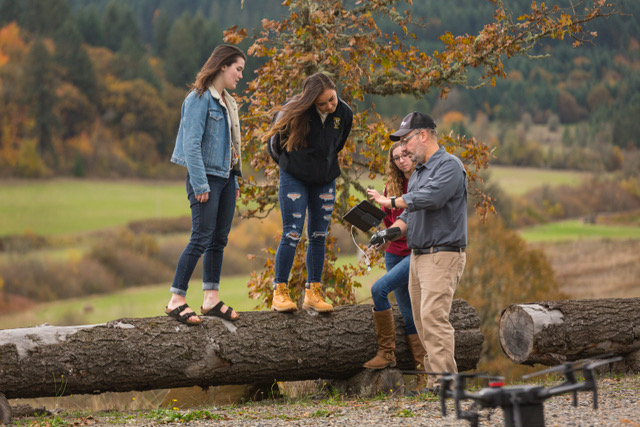
Willamette’s location brings tremendous opportunity for Environmental Science students to undertake meaningful and impactful internships. With the campus across the street from the Oregon State capitol, and just a few short blocks from Marion County government offices and Salem City Hall, Environmental Science students have the opportunity to intern with legislators and policy leaders and work in the field with environmental engineers and researchers. Students also may choose to gain experience working with many of the nonprofit organizations in the region including those that focus on public health, education, and social justice issues.
The Environmental Science department strives to give our students practical research experience. Often, these projects result in publications in peer-reviewed journals. A few examples of recent publications are below. Student authors are underlined.
Keuler, M, &Levine, R.(2025). The Marion County Climate & Health Adaptation Plan, July 2025-June 2030. Health & Human Services, Marion County, Oregon.
Iroz-Elardo, N. & Butterworth, M. (2024). Marion & Polk County Regional Environmental Scan Assessment for Environmental Health Resiliency – Final Report for #HE-5459-23.
Marion County Health & Human Services. Salem, Oregon. Lead student authors:Christian Crow, Aissatou Coyle,Rose Grimson,Jacqueline Hall, Emery Kerani.
Pike, S., Sheedy, K, andFamiletto, E. (2022). A first report of the white marble from the Sangri Valley in Southern Naxos, in Asmosia XIII. Proceedings of the 13th International Conference of the Association for the Study of Marble and Other Stones of Antiquity, Vienna 19–24 September 2022, SoSchrÖAI 65, 191-197.
Wang, A. X., Philpott, L., & Applequist, W. L. (2023). Elevation of three varieties of the Malagasy endemic Casearia nigrescens (Salicaceae) to the species level. Novon: A Journal for Botanical Nomenclature, 31(1), 191-197.
Pike, S. and Shinsato, L, 2020. Geochemical analysis of the clay floors from Structure 14 using a portable XRF. In Ness of Brodgar: As it Stands, Card, E., Edmonds, M and Mitchell, A. (eds), The Orcadian Press, Kirkwall, UK.
Copes-Gerbitz, K., K.B. Arabas, andE.R. Larson. 2017. A Multi-Proxy Environmental Narrative of Oregon White Oak (Quercus garryana) Habitat in the Willamette Valley, Oregon. Northwest Science. 91(2) 160-185.
Gildehaus, S., K. Copes-Gerbitz, K.B. Arabas, and E.R. Larson. 2015. The Dendroclimatological Potential of Willamette Valley Quercus garryana. Tree Ring Research 71(1): 13-23
Arabas, K.B., K.S. Hadley, and E.R. Larson. 2006. Fire history of a naturally fragmented landscape in central Oregon. Canadian Journal of Forest Research 36(5): 1108-1120.
Butterworth, M., Davis, G., Bishop, K., Reyna, L., & Rhodes, A. (2020). What Is a Superfood Anyway? Six Key Ingredients for Making a Food “Super”. Gastronomica, 20(1), 46-58.
To encourage professional growth and to provide real-world experiences to our students, ENVS faculty have supported student participation at regional and national conferences. Examples of conferences and workshops recently attended by students include
- The Geological Society of America Annual National Conference
- The American Geophysical Union Annual Conference
- Society for Ecological Restoration, Northwest Chapter Regional Conference
- American Dendroecology Conference
- Annual Meeting of the Association of American Geographers
- International Wildland Fire Ecology and Fire Management Congress
- Northwest Climate Conference
- Murdock College Regional Science Conference
The objective of the Science Collaborative Research Program (SCRP) is to provide selected undergraduate students the opportunity to work directly with faculty in the natural sciences on a nine-week summer research project. A $6000 stipend is provided to participating students.
The National Science Foundation makes possible a number of opportunities for undergraduates to join research projects each summer. This allows students to experience first-hand how basic research is carried out, and to contribute consequentially. The principal support by NSF of such activities is through the Research Experiences for Undergraduates Program.
Carson Grants offer Willamette undergraduates the opportunity to undertake a scholarly, creative, or professional research project during the summer. Approximately 10 grants of up to $3,000 are available each year. Students may apply for these competitive grants either as sophomores or juniors. Projects may be creative and artistic, literary, investigative, interdisciplinary, and performative.
College Colloquium Student Research Grants offer Willamette undergraduates the opportunity to undertake a scholarly, creative, or professional research project during the summer between their first and second years. Approximately six grants of up to $3,500 are available each year. Students may apply for these competitive grants only as first-year students. Projects must be related to the subject of the applicant's College Colloquium. Projects may be creative and artistic, literary, investigative, interdisciplinary, and performative.