Exercise and Health Science
Exercise and Health Science / Laboratory Testing
Laboratory Testing
The Department of Exercise and Health Science offers fee-for-service laboratory testing. These tests are available to the general public. Willamette University community members may inquire about a discounted rate.
Currently available tests:
For more information, or to make an appointment, please contact us at wu-exercise-testing@willamette.edu.
Body Composition Assessment Test
What a Body Composition test can tell you:
A body composition test can provide you with an accurate estimation of your respective percentages of fat and fat-free body mass. Fat mass is comprised of essential fat, that which is important for healthy body function, and storage fat, that which accumulates around organs and under the skin when there is an excess of energy available. Fat-free mass is made up of muscle, bones, and other organs. Your Body Mass Index (BMI) does not account for body composition. Having excess weight is not the same as excess fat; knowing your weight alone can be somewhat misleading. With a body composition test, you will be able to find out just how much of your weight is fat mass. A high percentage of fat mass has been shown to increase your risk for certain diseases including heart disease and diabetes, while an extremely low percentage of body fat can pose other health risks, especially for women. At the end of your test you will be provided with a handout which lists your percentages of fat and fat-free mass and compares these values to norms. You will be placed in one of six categories: risky – high body fat, excess fat, moderately lean, lean, ultra lean, and risky – low body fat. Additionally, you will be given an estimate the number of calories you can eat to gain, lose, or maintain your current weight based on your activity level. If you decide that it is necessary, you can positively change your relative percentages of fat and fat-free mass by altering your diet and exercise habits.
What to Expect:
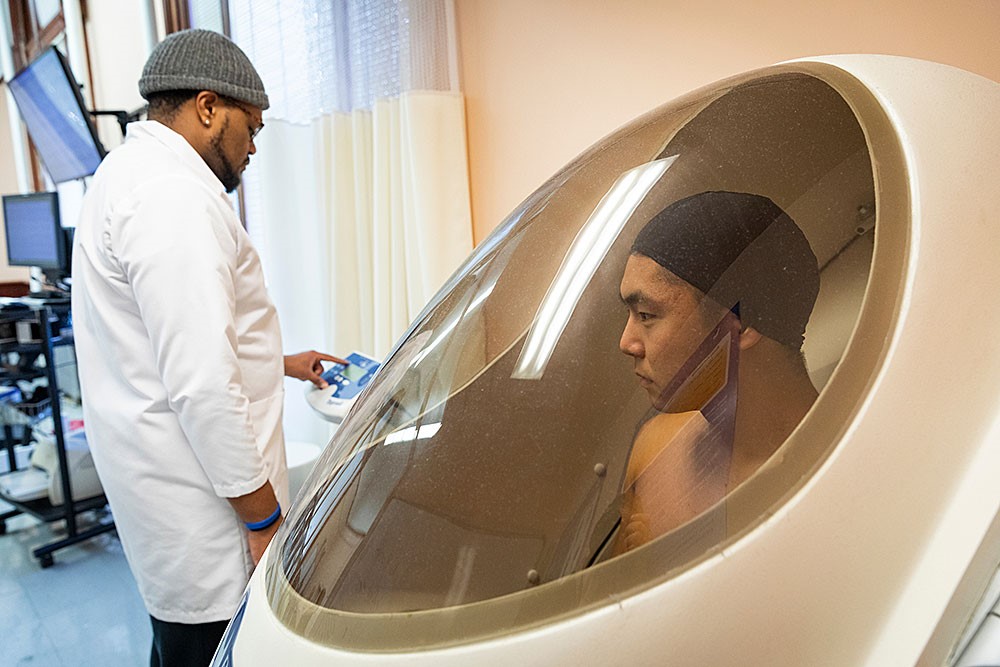
Here at Willamette, you will be able to use one of the most accurate and least intrusive methods of measuring body fat, the Bod Pod. The Bod Pod is considered just as accurate, if not more accurate, than the previous gold standard for measuring body composition, hydrostatic weighing. For a body composition test, it is important that you arrive to our facilities without having exercised for at least two hours. You will need to wear minimal, skin-tight clothing such as a swimsuit or compression shorts and/or a sports bra to get an accurate reading. Initially you will be weighed on a scale that is connected to the Bod Pod system. You will then sit quietly in the Bod Pod for three short sessions, between which your technician will open the door and allow the system to recalibrate. The entirety of the test should take no longer than 10 minutes.
How Body Composition is measured:
Your percentages of fat and fat-free mass are calculated using body volume and body weight. The Bod Pod measures air volumes by carrying out pressure changes within the chamber and applying the gas law: (initial pressure) × (initial volume) = (final pressure) × (final volume). Body volume is then found by subtracting the volume of air in the Bod Pod chamber with the subject sitting inside from the total volume of air in the empty chamber. Body weight is divided by body volume to yield body density. Using the fact that fat-free mass weighs 1.1 g/compared to fat mas, which weighs 0.9 g/mL, the following equation which provides body composition is derived: % fat mass = (495 ÷ body density) - 450.
Resting Metabolic Rate Test
What an RMR test can tell you:
The Willamette University Department of Exercise and Health Science is now offering resting metabolic rate testing. Resting metabolic rate (RMR) is the number of calories your body utilizes per day to maintain the basic body functions while at rest. RMR makes up 60-75% of your daily energy expenditure. This value is typically expressed as a number of kilocalories per day. Factors affecting RMR include thyroid hormone regulation, epinephrine levels, and individual muscle mass. If you know your RMR, you can better estimate your caloric balance, which can help you develop strategies to achieve your weight gain or weight loss goals.
What to Expect:
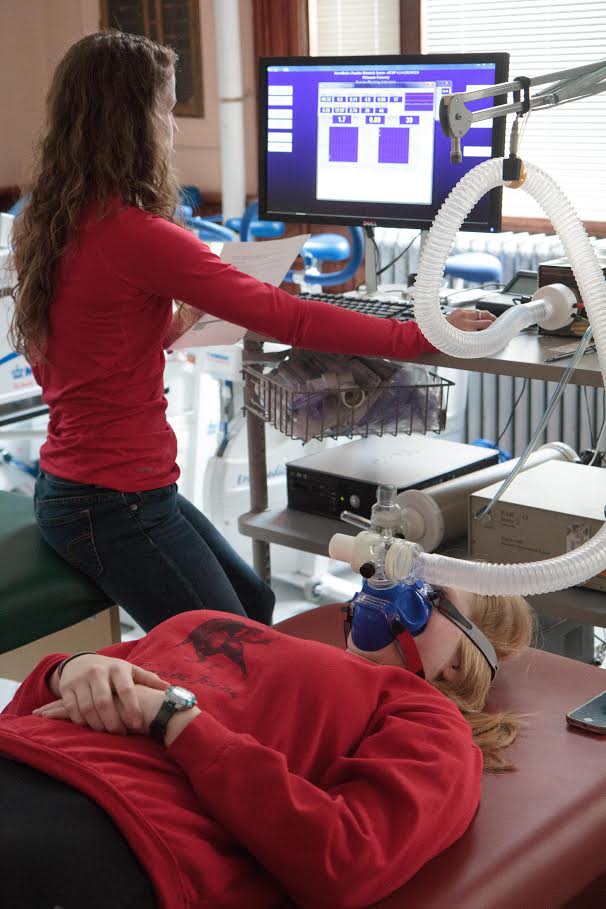
For an ideal RMR test, it is advised that you arrive having fasted for 12 hours. This test is designed to find your resting metabolic rate, so it is recommended that you arrive mentally relaxed and having had a good night’s sleep. Upon arrival you will be oriented with the procedures of the test. A metabolic cart will be measuring the contents of the air you exhale through an expiratory tube connected to a secured facemask; you will be breathing in unaltered air from the room. After the equipment has been applied, you will assume a supine position and a program on the attached computer will measure your volume of oxygen consumption, volume of carbon dioxide production, respiratory exchange ratio, and heart rate over a period of 20 minutes. During the testing period it will be recommended that you keep your eyes closed and stay as calm as possible, without falling asleep, as this will affect results. The most stable 5 minutes of testing will be averaged and used in calculations.
How RMR is calculated:
RMR per minute is calculated using the following equation: VO2/min × Thermal Equivalent. The thermal equivalent is a value derived from your averaged respiratory exchange ratio that expresses the kilocalories burned per liter of oxygen consumed.