Frost Lecture Series
The Frost History Lecture Series was made possible by a generous gift in 2011 from Allan BA'64 and Fran Frost. Allan and Fran established the Frost History Lectureship Fund in honor of Allan's brothers O.W. "Jack" Frost, an English professor at Willamette from 1954-1963, and his brother David Frost BA'57, LLB'60. An additional gift was made by Mary B. Frost in 2022 in memory of her husband O.W. "Jack" Frost.
O.W. “Jack” Frost obtained his BA, MA and PhD in English from the University of Illinois. He taught English at Willamette from 1954 to 1963 where he developed and administered the Honors Program. . After his time at Willamette, he moved to Anchorage to be the Dean of Liberal Arts at Alaska Pacific University where he spent the rest of his career. He established a university press and championed Native Alaskan prose and poetry. He became interested in Alaskan history late in his career. He was drafted in to WWII out of high school and was a soldier in the Pacific Theater with the Alamo Scouts in the Philippines. His scholarship provided a major contribution to the history of maritime exploration, as he pioneered research in this field throughout his lifetime.
In 1988 O.W. Frost published a translation of Georg Wilhelm Steller’s journal, titled Journal of a Voyage with Bering, 1741-1742. This publication documents the first Russian-led voyage to the northwest coast of America, and the beginning of Alaska’s recorded history. George Wilhelm Steller (1709 - 46) was a German naturalist and academician who accompanied Captain-Commander Vitus Jonassen Bering aboard the St. Peter on an unforgettable journey. O.W. Frost describes the importance of publishing Steller’s journal, “A source document of invaluable historical importance, it is also a narrative of bitter human conflict, of nature as an overwhelming adversary, and of deliverance from death for scarcely more than half the crew.”
In 2003 O.W. Frost published the first biography of Captain-Commander Bering in over a century, Bering: The Russian Discovery of America. The book chronicle Bering's adult-life, including his expansion of the Russian empire and his pioneering of the geography of the Northern Pacific Ocean. The book is a major contribution to maritime exploration history as well as an engrossing account of Berings successes and trials.
David Frost received an undergraduate degree in Economics (1957) from Willamette University and also completed his LLB from Willamette Law School (1960). He practiced law in Hillsboro for more than 40 years and served two terms as a State Representative in the Oregon Legislature. He also was the corporate attorney for Tuality Healthcare and the attorney for numerous cities in western Oregon. David had three children who are also Willamette graduates.
Allan Frost graduated from Willamette in 1964 as a chemistry major and continued his medical education at the University of Minnesota. He practiced ophthalmology in Twin Falls, Idaho until his retirement in 2007. He and his wife Fran, have one daughter Marin who graduated from Willamette in 1990 and now lives in Wilsonville. Fran was a history major at Washington State University; they are delighted that they could contribute to the creation of this history series.
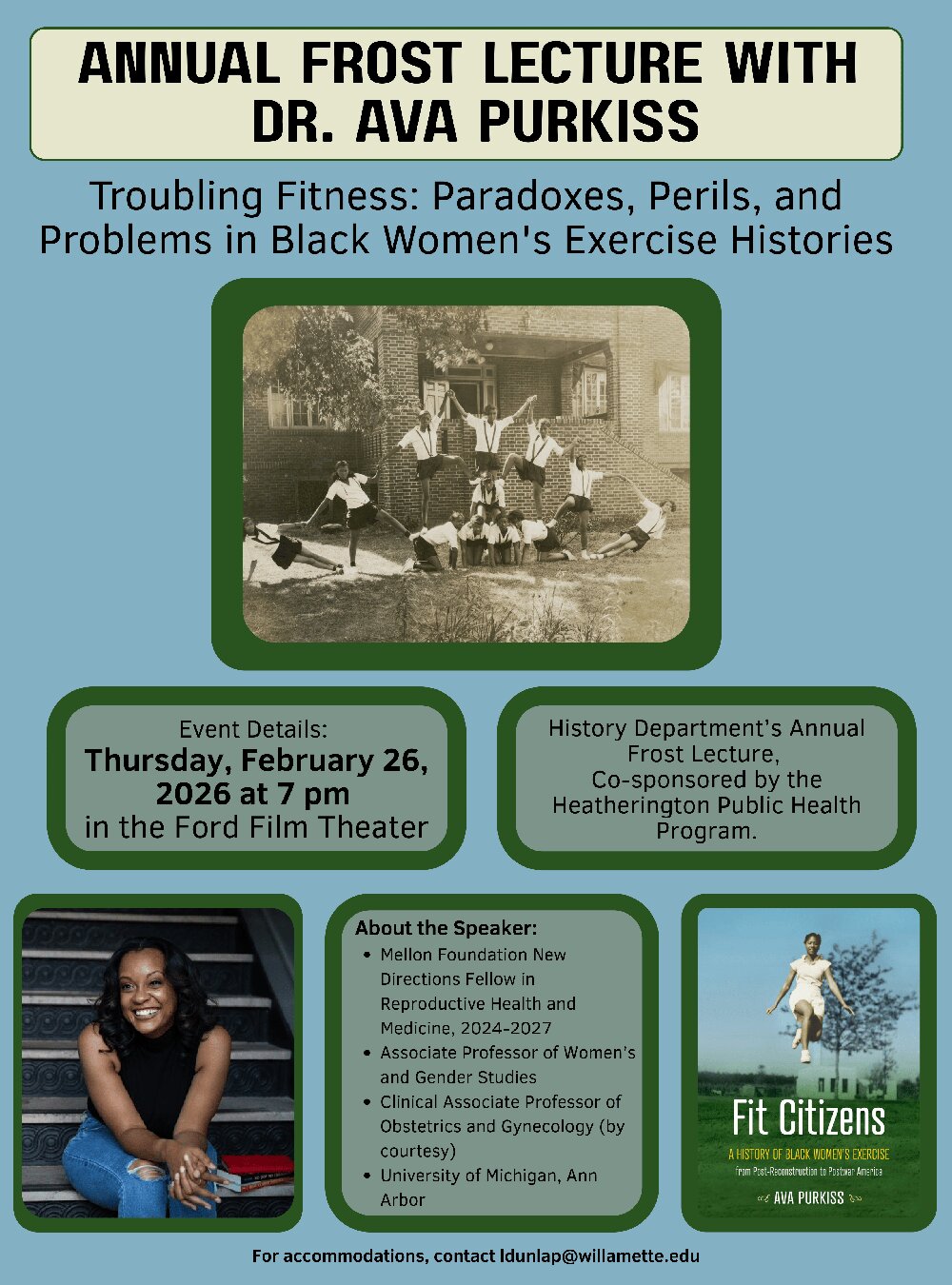
2026 Lecture
2020 Lecture
Jessica Wilkerson has a joint appointment in History and Southern Studies. Born and raised in East Tennessee, she earned her MA in Women’s History from Sarah Lawrence College and PhD in History from the University of North Carolina at Chapel Hill. Her first book, To Live Here, You Have to Fight: How Women Led Appalachian Movements for Social Justice (University of Illinois Press, 2019), traces the alliances forged and the grassroots movements led by women in the Appalachian South in the 1960s and 1970s. The project, based on her dissertation, received the OAH Lerner-Scott Prize and the Labor and Working-Class History’s Herbert Gutman Prize.
Wilkerson’s article “The Company Owns the Mine But They Don’t Own Us: Feminist Critiques of Capitalism in the Coalfields of Kentucky,” was published in April 2016 in Gender & History and received the A. Elizabeth Taylor Prize for the best article in women’s history from the Southern Association for Women Historians. She has also published in Southern Cultures and Working U.S.A.: The Journal of Labor and Society, and she contributed to North Carolina Women: Their Lives and Times—Volume 2 (University of Georgia Press). She has contributed to oral history projects at the Southern Oral History Program (UNC), including the “Long Women’s Movement in the American South.” You can hear more about that project here. In the spring 2017, she began a collaboration with her students on an oral history project documenting LGBTQ life and history in Mississippi. She has also written for 100 Days in Appalachia, Salon, Rewire News, Washington Post,and Longreads. Her research interests include women’s and gender history, working-class history, U.S. social movements, Appalachian history, and oral history.
Professor Wilkerson teaches classes in southern history, women’s and gender history, contemporary U.S. history, and oral history.
2019 Lecture
Iran and the United States since 1833: From Missionary Labor to Projection of Power
Professsor Abbaas Amanat, Graham Sumner Professor of History at Yale and Director of the Yale Program in Iranian Studies.
February 14, 2019
Abbas Amanat is William Graham Sumner Professor of History at Yale and Director of the Yale Program in Iranian Studies. His most recent book is Iran: A Modern History (Yale University Press, 2017). His other publications include: Apocalyptic Islam and Iranian Shi’ism; Pivot of the Universe: Nasir al-Din Shah Qajar and the Iranian Monarchy; and
Resurrection and Renewal: the Making of the Babi Movement in Iran. His recent co-edited volume, Persianate World: A Conceptual Inquiry, is published by Brill in 2018.2018 Lecture
The First Crusade and Jewish Martyrdom
Professor William Chester, Princeton University, Phi Beta Kappa Visiting Scholar
October 15, 2018
Biography: William Chester Jordan is Dayton-Stockton Professor of History. He is a former Director of the Program in Medieval Studies and has also been Director of the Shelby Cullom Davis Center for Historical Studies (1994 to 1999). He is the author of several books:Louis IX and the Challenge of the Crusade: A Study in Rulership(Princeton University Press, 1979);From Servitude to Freedom: Manumission in the Sénonais in the Thirteenth Century(University of Pennsylvania Press, 1986);The French Monarchy and the Jews from Philip Augustus to the Last Capetians(University of Pennsylvania Press, 1989);Women and Credit in Pre-Industrial and Developing Societies(University of Pennsylvania Press, 1993);The Great Famine: Northern Europe in the Early Fourteenth Century(Princeton University Press, 1996; awarded the Haskins Medal of the Medieval Academy of America);Europe in the High Middle Ages(Penguin, 2001);Unceasing Strife, Unending Fear: Jacques de Thérines and the Freedom of the Church in the Age of the Last Capetians(Princeton University Press, 2005);A Tale of Two Monasteries: Westminster and Saint-Denis in the Thirteenth Century(Princeton University Press, 2009), andMen at the Center: Redemptive Governance under Louis IX(Central European University Press, 2012). His most recent book isFrom England to France: Felony and Exile in the High Middle Ages(Princeton University Press, 2015). Professor Jordan has edited a one-volume encyclopedia of the Middle Ages for elementary school pupils (Franklin Watts, 1999) and a four-volume version for middle school students (Scribner's, 1996). He was the editor-in-chief of the first supplemental volume of theDictionary of the Middle Ages(Scribner's, 2004). He is a Fellow of the Medieval Academy of America, the American Philosophical Society, and the American Academy of Arts and Sciences. His current research focuses on French-English relations in the thirteenth and early fourteenth century. From January 2009 to January 2010 Professor Jordan served as President of the American Catholic Historical Association. In 2011-2012 he served as President of the Fellows of the Medieval Academy of America, and in March 2012 and April 2013, he was elected Second Vice-President and First Vice-President of the Academy respectively. He served as President in 2014-2015.
2017 Lecture
Some Historical Lessons from the Transpacific Western: Clint Eastwood and Lee Sang-il
Takashi Fujitani, Professor of History and Dr. David Chu Chair in Asia-Pacific Studies at the University of Toronto
ABSTRACT: In this presentation Professor Fujitani reads Clint Eastwood’s critically acclaimed Unforgiven (1992) against Lee Sang-il’s “remake” of the original (Yurusarezaru mono, 2013). While the few Anglophone critics who have reviewed Lee’s version have generally treated it as a competent but fairly unremarkable copy of the original, Fujitani argues that the film, set in Hokkaidō, is in many ways a far more radical and challenging exploration of key themes taken up by Eastwood that are of interest for those who study the past and its effects in the present. These include violence, law, the outlaw, sovereign power, the right to kill, and historical memory and accountability. At the same time, Lee takes up several issues that Eastwood simply leaves as background to his story -- in particular race, indigeneity, and settler colonialism. While the Western has been a staple genre in Eastwood’s long career leading up to Unforgiven, Yurusarezaru mono is the first and so far only Western made by the much younger Lee. Lee’s first film, Chong (1998, 2001), is in part based upon his own life growing up as an ethnic Korean in Japan. His more well-known films include Hula Girl (2006), The Villain (Akunin, 2010), and Rage (Ikari, 2016).
BIO: Takashi Fujitani is Professor of History at the University of Toronto where he also holds the Dr. David Chu Chair in Asia-Pacific Studies. Much of his past and current research has centered on the intersections of nationalism, colonialism, war, memory, racism, ethnicity, and gender, as well as the disciplinary and area studies boundaries that have figured our ways of studying these issues. His major works include: Splendid Monarchy (UC Press, 1996); Race for Empire: Koreans as Japanese and Japanese as Americans during WWII (UC Press, 2011) and Perilous Memories: The Asia Pacific War(s) (co-edited, Duke U. Press, 2001). He is also editor of the series Asia Pacific Modern (UC Press). He is currently working on several books: a postnationalist history of WWII in the Asia-Pacific; the question of sovereignty in twentieth century Japan; and Clint Eastwood and his entanglements with Asia.
2016 Lecture
Beyond the Popular: Epistemological and Historiographical Politics of African Music
Mhoze Chikowero, Associate Professor of African History
University of California, Santa BarbaraIn this Frost Lecture, Mhoze Chikowero centers his newly published book, African Music, Power and Being in Colonial Zimbabwe to present a multilayered history of African music in Zimbabwe and Southern Africa beyond the conventional framing of the “popular.” He proffers a new, critical intervention that engages with questions of power in both the musical cultures and the epistemological and historiographical battles that characterize scholarship on the subject. Much more than write a history of music, Chikowero utilizes music as an archive to write history from a critical African perspective. So central to African spirituality and wellbeing was music that, starting in the 1890s, European missionaries, ethnomusicologists and the incipient state targeted and sought to destroy, subvert or domesticate it in their bid to culturally disarm and colonize the Africans. And it was partly through the same musical practices that Africans fought colonial subjugation both during the First Chimurenga (war of self-liberation) in the 1890s and the Second Chimurenga in the 1960s-70s. For Chikowero, Zimbabwean (and much of Southern African) song therefore constitutes a Chimurenga archive for writing robust, hitherto silenced histories of African being and self-liberation.
2015 Lecture
Capitalism and Slavery: Not an Accidental Connection
The story of capitalism's origins is a story about our origins. In his controversial new book, Cornell historian Ed Baptist argues that slavery in the United States was much more deeply connected to the origins of American capitalism than we like to think. He will talk about how and why he came to research this connection, and its human consequences.
Ed Baptist grew up in Durham, North Carolina, and received his undergraduate degree from Georgetown University. He did his graduate work at the University of Pennsylvania. Since then, he has taught first at the University of Miami, and, since 2003, at Cornell University. He will be speaking about his new book, The Half Has Never Been Told: Slavery and the Making of American Capitalism, published by Basic Books in September 2014 (reviewed in the New York Times.
Ten years in the making, this sweeping history of the United States from the Revolution to the Civil War puts enslaved African Americans at the center of the story. Using interviews with ex-slaves, personal narratives written by survivors who escaped slavery, the business papers and secret letters of enslavers, as well as the newspapers and more public documents of American communities, this book argues that one can not understand how the American past is today’s prologue without understanding how American slavery grew and changed, became modern, and shaped the American nation.
Baptist has also published Creating an Old South: Middle Florida’s Plantation Frontier Before the Civil War (UNC Press, 2002), and with the late Stephanie Camp, New Studies in the History of American Slavery, (University of Georgia Press, 2006). He and Louis Hyman have also published a co-edited book called American Capitalism: A Reader, which was published by Simon and Schuster as an e-book.
At Cornell, Baptist teaches about the history of slavery, the U.S. Civil War, American capitalism, and digital history, as well as a service-learning course that brings American students to work in the schools of a community in rural Jamaica.
Along with Louis Hyman, he has developed and taught The History of American Capitalism, a MOOC (Massive Open Online Course) for CornellX. He conceived of this as being more of a multi-form, dynamic textbook for use by other teachers in their own classrooms than a stand-alone course. Baptist is also leading a project called Freedom on the Move, a collaborative effort in digital history that is building a crowdsourced database of all fugitive slave ads.
2014 Lecture
Reckoning with the Confederacy: Reflections on Historical Practice
In her talk, Professor Stephanie McCurry reprised about the main arguments of her 2010 book Confederate Reckoning: Power and Politics in the Civil War South(Harvard University Press, 2010): the nature of the Confederate nation-making project; the terrible reckoning - including with its own people - that came with war; and the radically transformative consequences of white southerners' risky gamble on proslavery nationalism. She reflected on the methodological challenges involved in trying to write a new kind of political history focused on the disfranchised.