Emergency Preparedness Guide
This Emergency Preparedness Guide is designed to help you respond quickly and effectively to a variety of situations. Although not exhaustive; this guide offers direction to support your safety during various types of emergencies.
Download the Quick Reference Guide - Salem (PDF Document)
Download the Quick Reference Guide - PNCA (PDF Document)
Table of Contents
- Introduction and General Information
- Emergency Assistance
- Personal Responsibilities
- Media Communications
Emergencies
- Armed Intruder or Active Threat Response
- Medical Emergencies
- Automated External Defibrillator (AED) Locations
- Air Quality
- Fire
- Natural Disasters/Emergency Actions
- Floods
- Earthquakes
- Snow and Ice
- Chemical Spills
- Biological Spills (blood)
- Persons/Weapons Threat
- Bomb Threat
- Utility Failure
Emergency Response
- Emergency Response Team
- Emergency Preparedness Equipment
- Emergency Communications Center (EOC)
- Campus Evacuation Plan
- Where do volunteers report?
- Emergency 866 (800) Number Information
Introduction and General Information
An emergency is any situation that endangers the safety or lives of students, staff, faculty or visitors on Willamette University property.
This Emergency Preparedness Guide is designed to help you respond quickly and effectively to a variety of situations. Although not exhaustive; this guide offers direction to support your safety during various types of emergencies. Campus Safety officers are on campus 24 hours a day to respond to and assist during emergencies.
It is recommended that you read this guide in advance of an emergency.
- In the event of an emergency, a comprehensive Emergency Action Plan may be activated. The Office of Campus Safety is designated as the Emergency Operation Center (EOC), unless the emergency makes this location unusable, in which case, an alternate location will be designated.
If you require special accommodations or assistance in an emergency, contact Accessible Education Services (AES) if a student or Human Resources if an employee, to put plans in place ahead of an emergency.
Emergency Assistance
For assistance in an emergency call Campus Safety (Salem: 503-370-6911 | PNCA: 503-621-2061). If assistance from 911 is required, and two witnesses are available, one should call Campus Safety, the other should dial 911. If only one is available, call Campus Safety who can assist with calling 911.
Campus Safety can assist Police, Fire and Emergency Medical responders in accessing the emergency. This includes directing to specific buildings and providing addresses, unlocking buildings, and escorting responders to the location of the incident.
When you call:
- Identify yourself and the location of the emergency.
- Describe the emergency.
- Report any known or suspected injuries.
- Identify immediate help needed.
- If appropriate or directed to do so, dial 911.
Personal Responsibilities
In an emergency, your first responsibility is to protect yourself. If you are injured, you cannot assist others. Once you are safe, help those nearby if you are able.
Media Communications
Eemergency situations may attract media interest and requests for information. Managing the University’s interaction and communication with the media through a central point of contact is an important part of emergency response procedures.
- If you are contacted by the media, refer the individual to Vice President for Communications in the President’s Office. . Responses to media inquiries should be limited to the following statement: “In order to ensure that we provide the most timely, accurate information, please contact Media Relations at (503) 370-6274.
- If the President’s Office is closed, contact Campus Safety at Salem: 503-370-6911 | PNCA: 503-621-2061 who will direct communication to the Executive Director of Campus Safety.
- If an Emergency Operations Center (EOC) has been established, media requests may be directed to the incident commander.
Armed Intruder or Active Threat Response
RUN, HIDE, FIGHT
An armed intruder or active threat requires immediate action. Follow the national Run–Hide–Fight protocol. Call Campus Safety (Salem: 503-370-6911 | PNCA: 503-621-2061) and call 911 as soon as it is safe to do so. In situations where it is not safe to make a phone call, you may also text Campus Safety (Salem: 503-370-6911 | PNCA: 503-621-2061).
RUN
If you can safely escape, this is your first and best option.
- Leave immediately. Do not wait for others to follow.
- Leave belongings behind.
- Warn others along your escape route
- Once safe, Call Campus Safety and 911, provide information about:
- The shooter or threat
- Their location
- Their direction of travel
- Weapons involved
If you are outside when the threat occurs:
- Move away from buildings and find hard cover (walls, vehicles).
- Continue moving until well beyond the affected area if necessary
HIDE
If evacuation is not safe, shelter in place and secure your location.
- Get out of view and stay quiet.
- Lock and barricade doors.
- Turn off lights; close blinds or cover windows.
- Silence all phones and electronic devices (including vibration alerts).
- Spread out. Do not cluster in groups.
- Take cover behind hard cover objects (concrete walls, heavy desks, filing cabinets).
- Communicate when possible:
- Text Campus Safety (Salem: 503-370-6911 | PNCA: 503-621-2061)
- Place a sign in a window if safe to do so.
- Stay hidden until Law Enforcement or Campus Safety give further direction.
If you are in an open area and cannot run:
- Hide behind the most substantial cover available.
- Stay low and remain quiet.
FIGHT
If you are confronted and your life is in immediate danger
This option should only be used when there are no other choices.
- Commit to your actions.
- Use aggressive, decisive force.
- Improvise weapons (chairs, fire extinguishers, books, scissors, backpacks).
- Work as a team to overwhelm the attacker.
- Your goal is to incapacitate the intruder long enough to escape.
- Anyone locked out of a room should:
- Evacuate away from the threat if safe
- If unsafe to evacuate, seek the nearest secured space and shelter in place.
- Do not open locked doors for anyone once barricaded unless directed by police.
- Do not leave hiding places until Law Enforcement provides direction.
- Follow all police commands. Officers may pass by injured individuals while securing the area, eliminating the threat is priority, medical assistance will follow.
Medical Emergencies
- Call Campus Safety (Salem: 503-370-6911 | PNCA: 503-621-2061)
- Identify your location: building name, floor, room/office
- Describe the situation
- Types of injuries
- What help is needed
- Campus Safety will call 911 if appropriate.
Automated External Defibrillators (AED)
In case of a cardiac emergency, there are several Automated External Defibrillators (AED) located in the following locations:
Salem Campus
Non-Residential Buildings:
- Atkinson/West Annex – Near the water fountain
- Campus Safety Patrol Vehicle – In the trunk
- College of Law – Near Room 202
- Ford Hall – First floor, near theatre
- Goudy Commons – Near the dish collection area
- Hallie Ford Museum – First floor, in the bottom west cabinets near the security podium
- Hatfield Library – Near the circulation desk and stairs to second floor
- McCulloch Stadium – Near baseball lockers and stairs to second floor
- Montag Center – Between the Montag Den and Montag Center doors
- Olin Science Center – Second floor breezeway, heading toward Collins
- Oregon Civic Justice Center – Reception area, between south offices
- Pelton Theatre – In the lobby near the restroom
- Putnam University Center – North side, near the Bistro
- Rogers Music Center – Near service desk, next to Room 108
- Smith Auditorium – Outside the auditorium
- Smullin Hall – First floor, near main stairway
- Sparks Center
- Main lobby, near restrooms
- Lower level, near pool and weight room
- Waller Hall - Second floor, Cone Chapel
- University Services Building – In front of the Service Center desk
- WISH – In the lobby near the restroom
Residential Buildings:
- Baxter Complex – Outside the Bishop Wellness Center
- Doney Hall – First floor common area, near east entry
- Kaneko Commons – First floor Atrium, next to A wing (west side)
- Lausanne Hall – First floor, near main stairway
- Lee/York – In the kitchen common space area
- Matthews Complex – Matthews first floor common area
- Shepard Hall – First floor common area
- University Apartments (UAPS) – First floor, near vending machines
PNCA Campus
- 511 NW Broadway – near front entrance
- Glass Building - outside plaster lab
- Campus Safety patrol vehicle
Severe Injury or Death Notification
The University follows a coordinated, confidential process when responding to serious injury or death involving members of the campus community. These procedures apply to incidents occurring on campus and, when appropriate, to information received about events off campus.
Injury or Death On Campus
Immediate Response
- Call Campus Safety immediately and 911 if applicable
- Salem: 503-370-6911
- PNCA: 503-621-2061
- Campus Safety will:
- Dispatch officers to the scene
- Secure the area and restrict access
- Contact the Salem Police Department or Portland Police Bureau (PNCA)
- Notify the Executive Director of Campus Safety & Emergency Management
Notifications-Students
If a student is involved:
- Campus Safety will notify:
- The Executive Director of Campus Safety
- The Vice President for Student Affairs who will coordinate support and notification procedures
Notifications - Faculty/Staff
If a faculty or staff member is involved:
- Campus Safety will notify:
- The Executive Director of Campus Safety
- The Provost who will notify the appropriate Academic Dean
- The Assistant Vice President for Human Resources who will notify the appropriate manager
Information Release
- Next-of-kin notifications are conducted solely by law enforcement or the Medical Examiner. University employees must not contact family members directly.
- Any release of information to the public or media will be handled by the Vice President for University Communications or designee, in coordination with law enforcement and the Oregon State Medical Examiner.
- Employees must not release names or details to any off-campus person other than emergency responders and police.
Injury or Death Off Campus
When the University receives information about the off-campus death of a student, faculty member, staff member, or their immediate family:
- Campus Safety will:
- Verify the information with the appropriate authorities
- Notify the Executive Director of Campus Safety & Emergency Management
- Notify relevant University leadership (VP for Student Affairs, Provost, HR, Residence Life, etc.)
- Campus Safety will assist outside agencies as needed.
- The Bishop Wellness Center and University Chaplain will be activated to provide support to the campus community.
- If the deceased is a family member of a student or employee, Campus Safety may assist law enforcement in locating the individual and connecting them with appropriate support services.
Air Quality
Air quality is monitored in real time at a monitoring station located at Sparks building on our Salem campus and at the Moda Center in Portland.
If you are concerned about air quality, or have breathing/medical related issues, please view the live monitoring data AirNow to see if there are air quality alerts in the area. Concerns should be reported to Campus Safety.
Fire
Know the location of the fire emergency resources in your area:
- Fire extinguishers
- Fire exits
- Evacuation routes and assembly areas
If a fire occurs, or you detect smoke or a burning odor:
Call Campus Safety: Salem: 503-370-6911 | PNCA: 503-621-2061 and report:
- The location
- Current status of the fire.
- Your name and phone number
- Do not use elevators.
- Use a fire extinguisher if there is no danger to your personal safety in doing so. The acronym PASS can help describe how to use an extinguisher.
- P Pull
- A Aim
- S Squeeze
- S Sweep
- Move away from the exterior doors of the building to allow emergency responders to access the building.
- Follow the instructions of Campus Safety and fire department personnel. Do not re-enter the building until Campus Safety or Fire personnel give direction to do so.
Evacuation Guidelines for Individuals With Mobility Impairments:
1. Pre-Planning With Accessible Education Services (AES) or Human ResourcesStudents, staff, and faculty with mobility impairments are strongly encouraged to coordinate with Accessible Education Services (AES), if a student, or Human Resources, if an employee, for assistance developing a personal emergency evacuation plan. This planning should occur before an emergency takes place.
2. Evacuation Procedures During a Fire AlarmDuring a fire alarm or suspected fire, individuals who cannot use stairs should:
- Move to a nearby safe waiting area
- Notify Campus Safety immediately
- Do not use elevators
Campus Safety Officers or other responders may then:
- Assist using approved evacuation devices (stair chairs).
- Use manual carrying only as a last resort and when it can be done safely
Safe locations are chosen based on where the individual is at the time of the alarm.
Natural Disasters/Emergency Actions
Snow, ice, floods and earthquakes can all pose dangers for individuals safety and university facilities..
Severe Weather
If severe weather conditions develop, the University will provide updates through its mass notification system, which delivers alerts by text, email, and other designated channels. This system will communicate campus closures, delays, or changes to normal operations.
Closure information will also be posted on the University website.
Please do not call Campus Safety for closure updates, as this can tie up emergency phone lines.
Floods
In heavy rain, be aware of flash floods. If you are advised to evacuate:
- Secure the building.
- Lock the doors and windows
- Calmly leave immediately.
- Avoid driving through water
- Avoid basements/lower levels
- Do not walk through floodwater
- Avoid electrical equipment
- If evacuation is directed, do not return until cleared
Earthquakes
- If you are indoors during an earthquake, keep calm and take cover under a heavy table or desk. Stay away from glass, windows or anything that could fall, like a bookcase.
- If you are outdoors, move away from buildings, street lights and utility wires.
- Do not get into or use an elevator during an earthquake.
- After an earthquake, be prepared for aftershocks. Aftershocks are follow-up earthquakes that are usually smaller than the first one. They are dangerous because they can cause things that are weakened in the first earthquake to fall down.
Snow/Ice
- Freezing rain, sleet, heavy snow or sustained high winds can all pose a threat.
- Ensure your notification information is updated.
- Follow University instructions for closures
Chemical Spills
- Notify Campus Safety immediately (Salem: 503-370-6911 | PNCA: 503-621-2061).
- Priority is First Aid. Any spill that results in personal exposure should be treated immediately: Eyes/skin contact: Assist the person to a sink/eye wash station and flush eyes or affected skin area thoroughly and continuously for 15 minutes. Remove contaminated clothing making sure not to contaminate yourself in the process of helping.
- Evacuate the building if the spill is severe or dangerous and it is safe to do so. Identify the type of chemical and its hazardous characteristics to Campus Safety and other responders. Identify:
- Name of chemical
- Approximate quantity
- Location of spill
- Flammability
- Toxicity
- Corrosiveness
- Cleaning up chemical spills is dangerous and should only be performed by professionally trained individuals.
- Do not re-enter the area until the all-clear has been given by the team decontaminating the spill area.
Biological Spills (Blood)
Bloodborne Pathogens Standard (1991) requires that spills of blood and blood based biological spills be reported and the spill decontaminated.
- Call Campus Safety (Salem: 503-370-6911 | PNCA: 503-621-2061)
- Report if there is any need for medical attention.
- Identify the location of the blood spill.
- Keep bystanders away from the area
- Wait until help has arrived to begin cleanup procedures.
Persons/Weapons Threat
If you become aware of a person or situation that has intent to harm others or disrupt the safety or security of the campus
- Call Campus Safety (Salem: 503-370-6911 | PNCA: 503-621-2061), or send a text if the situation permits.
- Give your location.
- If it is safe to do so, give as much information as possible.
- Remain calm and do not make sudden movements.
- If it is safe to do so, leave the area.
Bomb Threat
Threat received by phone:
- Stay Calm. If the threat of an explosion is immediate, evacuate from the premises.
- Try to get as much information as possible about the location and description of the bomb, and the caller. Use the check list on the following page to make note of the caller’s attributes and threats.
- Stay on the line only as long as the caller continues to provide useful information.
- Call Campus Safety immediately (Salem: 503-370-6911 | PNCA: 503-621-2061)
If a suspicious item is discovered.
- If you find a suspicious device, Do not touch or disturb it.
- Do not use cell phones or other transmitting devices near the device.
- Once a safe distance away from the device call Campus Safety (Salem: 503-370-6911 | PNCA: 503-621-2061)
- Keep others away from the area until help arrives.
Bomb Threat Check List:
The Bureau of Alcohol, Tobacco & Firearms(ATF) has published the following checklist to be completed any time a bomb threat is received by telephone. It is important to complete the checklist as soon as possible after a call is received so details are not forgotten. Give the completed form to Campus Safety.
|
Exact time of call: 1. When is the bomb going to explode? 2. Where is the bomb? 3. What does it look like? 4. What kind of bomb is it? 5. What will cause it to explode? 6. Did you place the bomb? 7. Why? 8. Where are you calling from? 9. What is your address? 10. What is your name? |
Other information: If the voice is familiar, whom did it sound like? Were there any background noises? Remarks (attach additional sheets if necessary): Person receiving call: Telephone number call received at: Time and Date of call: (DD / MM / YYYY) |
Utility Failure
Electrical Power Loss:
- Call the Physical Plant at 503-370-6003. After hours, call Campus Safety (Salem: 503-370-6911 | PNCA: 503-621-2061)
- Use flashlights to navigate safely.
- Turn off electrical equipment and computer equipment. Some equipment could be damaged, if left on, when the power is restored.
- Recheck equipment when power is restored.
Water and Heat:
- Call the Physical Plant at 503-370-6003. After hours, call Campus Safety (Salem: 503-370-6911 | PNCA: 503-621-2061)
Telephone:
- For normal repairs, call Willamette Information Technology Services (WITS) at 503-370-6004.
- The emergency phones, located in red boxes on the outside of campus buildings, or emergency bluelight phones, have phone lines that will work in the event of an internal phone switch outage.
- If you need to reach Campus Safety, and are unable to do so using the campus phone system, call 503-851-6911, or call 911.
Emergency Response Team
The Emergency Response Team (ERT) is a group of university employees whose job responsibilities make them critical participants in a campus emergency. This team is led by the Executive Director of Campus Safety and Emergency Management or designee. Anyone on the team is authorized to activate the team. A Campus Safety officer on duty could also activate the team if a serious emergency occurs and an immediate response is required. When the team assembles and/or as the emergency requires, other University employees may assist the team. When the team is activated, they should report to the Office of Campus Safety unless otherwise instructed. The Office of Campus Safety is the primary Emergency Operations Center.
Emergency Preparedness Equipment
The University has purchased and assembled a supply of emergency equipment for the purpose of aiding in the response to an emergency. The Physical Plant has a supply of tools and materials to assist with many types of emergencies and these will be utilized as necessary. The Emergency Preparedness Equipment is designated, inventoried and stored for immediate access and response. The materials are located in the University Services Building Room 020.
Emergency Communications Center
An Emergency Operations Center is created during an emergency to coordinate the response to the emergency. The Office of Campus Safety is the primary location of the EOC. If the Office of Campus Safety is not usable because of the nature of the emergency, one of the following locations will be chosen:
- Hatfield Library
- College of Law
- University Center
- Olin Science
- Art Building
- Roger’s Music Center
Each of these buildings have emergency backup power.
Campus Evacuation Plan
If an emergency exists where it is no longer safe to occupy campus buildings or property, those areas should be evacuated
Salem Evacuation Assembly Areas - Main Campus
In the event of a campus evacuation, building occupants will report to the following locations.Click the evacuation locations below to view an evacuation map for each location.
Campus Map Overview
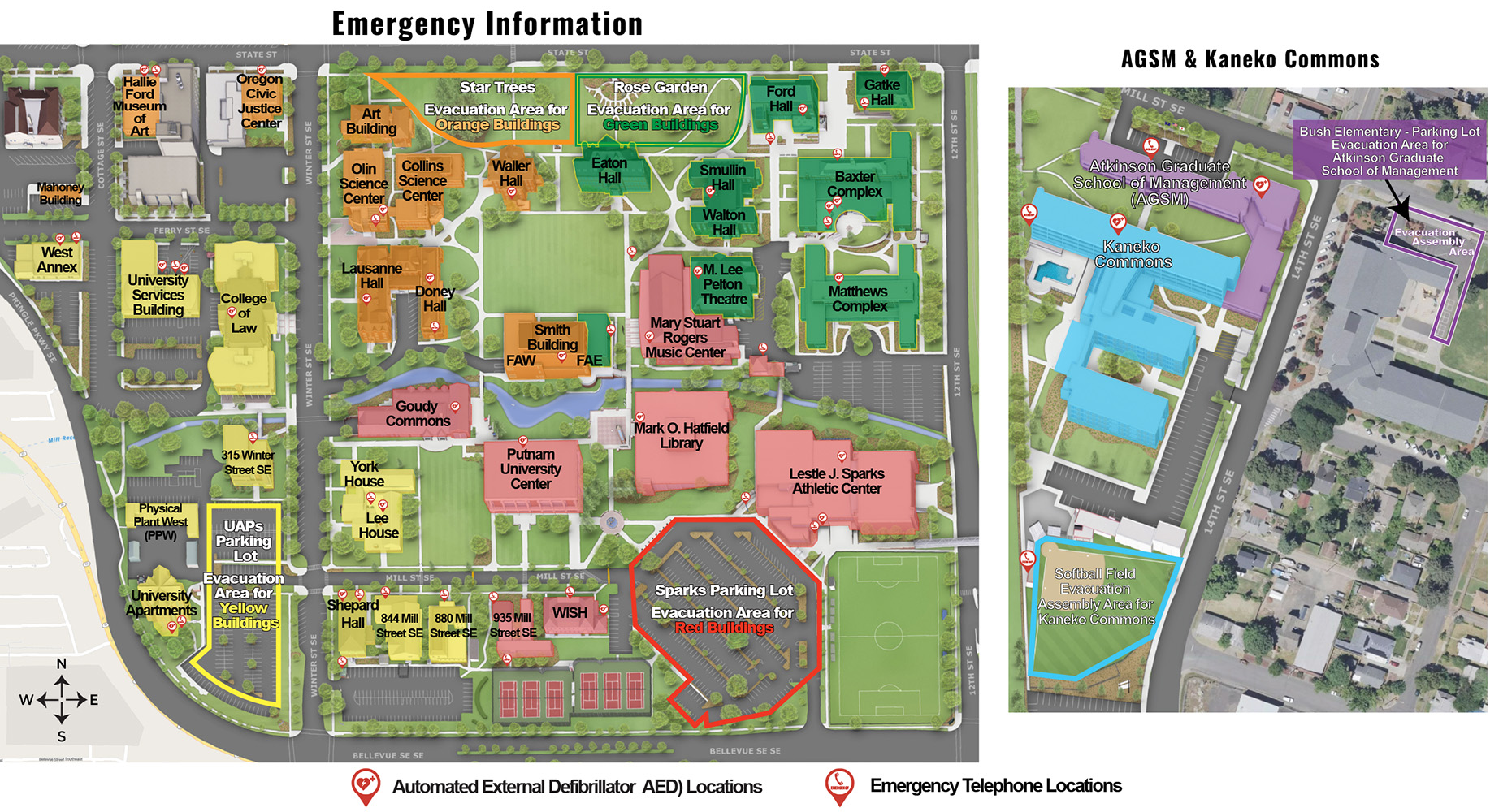
|
Evacuation Location / Map Color |
Buildings Reporting to Evacuation Location |
|---|---|
|
Art Building |
|
|
Baxter Complex |
|
|
935 Mill Street SE |
|
|
315 Winter Street SE |
|
|
Kaneko Commons (A,B,C Wings) |
|
|
Atkinson Graduate School of Management |
- If evacuation further from campus is required, McCulloch Stadium is the primary off campus location.
- If an emergency would require an evacuation to a location even further from campus, emergency personnel will designate an evacuation location.
Portland Evacuation Assembly Areas - Main Campus
In the event of a campus evacuation, building occupants will report to the following locations.
Click the evacuation locations below to view an evacuation map for each location.
|
Evacuation Location / Map Color |
Buildings Reporting to Evacuation Location |
|
511 Building |
|
|
ArtHouse |
|
|
Across Kerby Ave - Gather in front of building to the southwest |
Glass Building |
|
EcoTrust Building |
Where do volunteers report?
- In the event of an emergency, people often want to respond and help. Help is appreciated, but needs to be coordinated to maximize efficiency and the safety of the volunteers.
- Volunteers are asked to report to the Emergency Operations Center (EOC) for briefing and assignments, rather than reporting directly to the location of the incident. This ensures that volunteers are checked in and have the necessary information about the incident. It also helps ensure that volunteers are assigned to tasks where they are most needed. If assistance locating the EOC is needed, call Campus Safety (Salem: 503-370-6911 | PNCA: 503-621-2061)
Emergency 866 (800) Number Information
In addition to the Universities Mass Notification System, Willamette has an 866 number that may be used in the event of an emergency. Information will be updated, via a recorded message, on this 866 number if an emergency takes place.
The purpose of the 866 number is to avoid jamming communications in our internal phone system. The 866 number is located in an off-campus location and should operate even if the campus system is nonfunctional.
This number is 866-200-2089.