Classics: Ancient Coins in the HFMA
-
Silver Stater, 4th century BCE
weight: 10.3g (Persian standard), width: 2.36cm; die axis: 11h
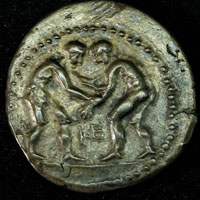
OBVERSE: In dotted circle, two wrestlers locked in opening hold; between them, mint mark FE (digamma epsilon).
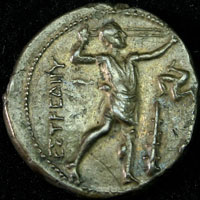
REVERSE: In dotted circle, slinger aiming sling right.
In left field, Greco-Pamphylian inscription ESTFEDIIYS (= Estwediiys, "Aspendian").
In right field, a triskeles of human legs (badge of the city); below that a club of Herakles and part of the Greek letter Phi.
HFMA nr. 2006.010.001. Ref.: Brixhe (1976) 195 nr. 11.Aspendos in Pamphylia, now the village Belkis on the southern coast of Turkey, was an important Greek colony and harbor city on the river Eurymedon, situated 11 km (7 miles) from the coast, safe from naval surprise attacks but with easy access to the Mediterranean Sea. In the fifth century BCE, the city began minting coins on the Persian weight standard then common in Persian-ruled Asia Minor.The wrestler-type, introduced in the fourth century, represents the best-known coins of Aspendos. As with other coins depicting athletes in the HFMA's collection (011, 016), the wrestlers on the obverse probably allude to a local victory in one of the Panhellenic games of which we have no other record.
The slinger on the reverse may be a punning reference to the city's name since sphendone ("sling") sounds similar to Aspendos. The triskeles (three human legs with bent knees arranged in a wheel-like formation) to the slinger's right is the city's badge.The Pamphylian ethnic on the reverse, Estwendiiys, corresponds to the Greek adjective Aspendios ("Aspendian"). The use of the Pamphylian language here and on many inscriptions found in the city suggests that Aspendos had a large indigenous population. At the same time, the Aspendians also liked to emphasize that their city had been founded by Greek settlers from Argos. In fact, the club of the Argive hero Herakles on the reverse may refer to the fact that Argos bestowed honorary Argive citizenship on all Aspendians in a decree from ca. 330-300 BCE that was set up in Nemea, the site of the Nemean games (SEG 34 242.4).
The FE on the obverse and the partially visible Phi on the reverse could be initials of the magistrates that supervised the city mint.
O.K.
Literature:
Brixhe, Claude, Le dialecte grec de Pamphylie: documents et grammaire. Paris, 1976, pp. 191-200. -
Silver Tetradrachm, Seleucia-on-the-Tigris mint
weight: 16.1g; width: 2.92cm; die axis: 1h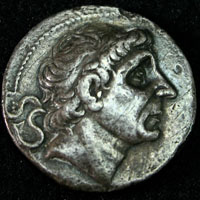
OBV.: : Diademed head of Antiochus I Soter (281-261 BCE) right, set in dotted border.
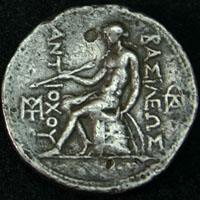
REV.: Naked Apollo sitting on the Delphic Omphalos, looking left down on an arrow, in dotted border. Apollo’s bow is leaning against the right side of the omphalos. Inscription left: "ANTIXOY" (= Antiochou, "of Antiochos"), right: "BASILEWS" (= Basileos, "of the king"). Control-marks: monogram left: MAT, monogram right: APO (?).
HFMA nr. 2006.010.002. Ref.: SNG Spaer 385 (= Newell, ESM 180) and Spaer 386 (both with same control-marks); cf. Houghton, CSE 955 (only MAT mark).
When Antiochus II (261-246 BCE) succeeded his father Antiochus I as king, the Seleucids had just suffered a defeat against Eumenes near Sardes (262 BCE). This defeat resulted in the loss of Pergamum, which became an independent kingdom that over the next one hundred years continued to grow at the expense of the Seleucids. Moreover, Ptolemy II Philadelphos of Egypt used the momentary weakness of his Seleucid rival to attack him in Asia Minor and Syria (Second Syrian War, 260-253 BCE).
Not surprisingly, the early coinage of Antiochus II promotes the idea of stable Seleucid rule by continuing the coin designs of his father, the late Antiochus I. The obverse shows Antiochus I as an older man with deep-set eyes and sharply-defined features and thus reflects his age (he was 48) when he defeated Celtic invaders, the Galatai, in 276 BCE, a victory that earned him the title Soter or Savior.
The reverse design, also introduced by Antiochus I, became the most common Seleucid reverse type. It shows the god Apollo sitting on the Delphic Omphalos with his attributes, bow and arrow. The Omphalos or "navel" was a sacred stone in Apollo's temple precinct in Delphi that the Greeks believed marked the center of the world. Its special status is marked by the tainiai or ribbons that criss-cross its surface.
Antiochus I had made Apollo the patron god of the Seleucids and built him a temple in Daphne near the Seleucid capital, Antioch-on-the-Orontes. On this posthumous coinage, the image of Apollo could also serve as a reminder that Antiochus II had declared his late father a god under the name Antiochus Apollo Soter (CIG 4458).
O.K.
-
Ptolemy II Philadelphos (285-46 BCE), Silver Tetradrachm, Sidon (Lebanon) mint, 250/49 BCE
weight: 13.7g; width: 2.63cm; die axis: 12h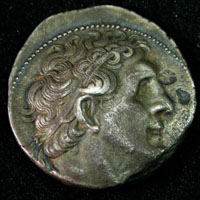
OBV.: Diademed head of Ptolemy I Soter (305-285 BCE) in dotted border; two bankers' marks in right field (flying bird and Taueret, the Egyptian goddess of childbirth).
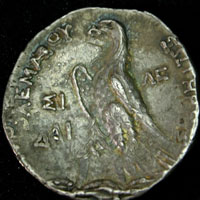
REV.: In dotted border, eagle with closed wings standing on a fulmen (thunderbolt); overstruck on similar die. Inscribed (PT)OLEMAIOU SWTHROS (= Ptolemaiou Soteros, "of Ptolemy the Savior"). Mint-marks in left field: SI (=Sidon) and DI; date in right field: LC (year 36 = 250 BCE).
HFMA nr. 2006.010.003. Ref.: BMC Ptolemies p.30 nr. 75; Svoronos 749.
The reign of the second Ptolemy (285-246 BCE) was a period of unequaled power and prosperity for the Ptolemaic kingdom. It comprised not only Egypt, but also Cyrene, Cyprus, Palestine, the coast of Asia Minor, and parts of the Aegean sea. After his general had successfully repelled the initial attacks of other diadoch kingdoms, Ptolemy could concentrate on making Alexandria the cultural capital of the world, aiming to increase the holdings of its famous library to 500,000 book rolls.
Ptolemy II was the first Ptolemy who went completely native in the sense that he not only assumed the title of Pharaoh, but also adopted the custom of his Egyptian predecessors and married his sister, Arsinoe II, after his first wife and the mother of his three children, Arsinoe I, had been accused of plotting against him. This incestual marriage, which Ptolemy immortalized on his coins, earned him later the nickname Philadelphos, "Sibling-Lover".
During his early reign, Ptolemy II continued to mint coins with the portrait of his late father. Ptolemy I (305-285 BCE) was the first successor of Alexander that had dared to portray himself on his coins, his hair bound with the Hellenistic symbol for kingship, the royal diadem. Ptolemy II's coins also proclaimed his deified father as Soter ("Savior"), a title the grateful Rhodians had bestowed on him in 305 BCE for delivering them from a siege.
The reverse, standard for all Ptolemaic coins, shows an eagle of Zeus holding Zeus' thunderbolt. Just like the thunderbolts on other coins, the eagle here symbolizes kingship. In addition, it may also have reminded Ptolemy's subjects of the most well-known Egyptian sanctuary to Zeus, the oracle of Zeus Ammon in the oasis of Siwa.
O.K.
Literature:Mørkholm, Otto, Early Hellenistic Coinage from the Accession of Alexander to the Peace of Apamea (336-188 B.C.), Cambridge 1991.
Svoronos, J. N., Ta Nomismata tou Kratous ton Polemaion, vol. 2, Athens 1904, translated by Catherine Lorber. -
Silver Stater or Didrachm, ca. 525/10 - ca. 480/78 BCE
weight: 7.8g, width: 2.14cm; die axis: 1h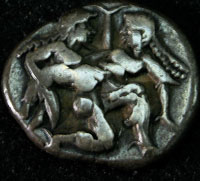
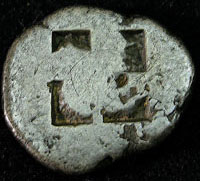
OBV.: Naked ithyphallic satyr running right with struggling maenad in his arms.
REV.: Quadripartite incuse square.
HFMA nr. 2006.010.004. Ref.: Picard (1990) Group I, Kraay (1976) p. 149-50 [nr. 519]
The motif of the satyr abducting a maenad (1) appears on several northern Greek coins. In the case of Thasos, an island just off the coast of Thrace in northern Greece, this Dionysiac motif serves to promote the island's famous wine.
Satyrs belong to the retinue of Dionysos, the god of wine. They are only interested in drinking wine and having sex, usually with the maenads, the female followers of Dionysos. Satyrs are commonly represented as half-man, half-horse or goat, often with a horse tail and pointy horse ears. On the obverse of this coin, however, the satyr has mostly human traits, except for his goat legs. In addition, his bestial nature is made clear by means of his nudity (which visibly contrasts with the maenad's modest dress, a long chiton), his obvious sexual arousal, and the fact that he is trying to abduct a maenad against her will, as evidenced by the fact that she is raising her right arm in protest.
This coin belongs to the first issues of Thasian coins, as indicated by the Y-shaped hand of the maenad (Picard 1990: 24).
(1) In connection with these coins, the maenad is often called a nymph. Ancient Greek vases, however, feature numerous scenes of satyrs pursuing or abducting female figures, and there they are always clearly characterized as maenads.
Literature:Anderson, Gary T., "Satyrs and Nymphs", Forum Ancient Coins.
Kraay, Colin M., Archaic and Classical Greek Coins. Berkeley; Los Angeles: University of California Press, 1976.
Picard, O., "Le monnaye de Thasos / The coinage of Thasos." Nomismatika Chronika 9 (1990) 23-27. -
Lampsacus (Mysia) mint, Gold Stater, 328-323 BCE
weight: 8.5g, width: 1.92cm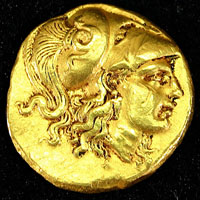
OBV.: Head of Athena facing right, wearing a crested Corinthian helmet adorned with a coiled snake.
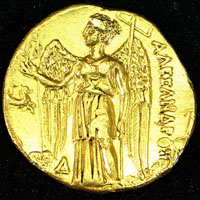
REV.: Winged Nike standing, facing left, holding a wreath in her outstretched right hand and a ship’s standard (stylis) in her left hand. Mint marks: Two horse-foreparts conjoined in left field, monogram "Di(o)" below left wing. Inscription ALEXANDROU (= "of Alexander") in right field.
HFMA nr. 2006.010.005. Ref.: Price (1991) nr. 1358.
The gold coins of Alexander the Great proclaim him as the leader of a unified Greece that fights together against the Persian barbarians. The goddess Athena on the obverse with her Corinthian helmet probably symbolizes the League of Greek States situated in Corinth that had elected Alexander, like his father Philipp before him, as their leader for the planned invasion of the Persian Empire.The winged victory goddess Nike is both a reminder of the glorious past and a representation of Greek hopes for a similarly glorious future. The naval standard that she holds in her hand probably alludes to the naval victory against the Persian invaders at Salamis in 480 BCE, and it promises similar victories under Alexander's leadership in the future.
O.K.
Literature:
Price, M., The Coinage in the Name of Alexander the Great and Philip Arrhidaeus: A British Museum Catalogue. Zürich: Swiss Numismatic Society/London: British Museum Press, 1991. -
O.K.
Silver Tetradrachm, ca. 450-440 BCE
weight: 17.0g, width: 2.32cmREV.: Archaic owl, slightly off-center to the left. In upper left, sprig of olive with two leaves and one berry in the center and a crescent touching shoulder and head of the owl. Inscription on the right: "AQE" (= ATHENAION, “of the Athenians”).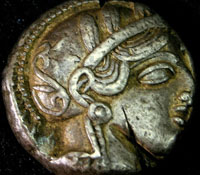
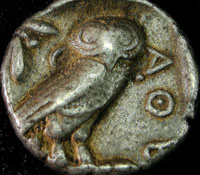
OBV.: Archaic head of Athena facing right. Her Attic helmet is decorated with a diadem of three olive leaves. Test cuts in Athena's throat and cheek.
HFMA nr. 2006.010.006. Ref.: Kraay (1976) 65 and 67 [nr. 198].
The famous "owls" of Athens, introduced at the end of the sixth century BCE and minted from the rich silver deposits at Laurium in southern Attica (map), became one of the first international currencies. Athens imported goods from all over the Mediterranean, and the conservative design of its coins, which hardly changed for several hundred years, promoted their reliably high and unchanging silver content.
The obverse of this coin shows the helmeted head of Athens' patron deity, Athena. Even though the coin was minted in classical times, this head still preserves its archaic smile and almond eyes. The stylized olive wreath on the helmet may commemorate the battle of Salamis in 480 BCE, in which the Athenian navy under Themistokles inflicted a decisive defeat on the fleet of Xerxes during the second and last Persian attempt to invade Greece.
Owls were reputed to be wise, and thus the Little Owl on the reverse is sacred to Athena as the goddess of wisdom. The olive sprig in the upper left is also a reference to Athena. The olive tree was a gift of Athena to the city, and at the Panathenaic games in honor of Athena, amphorae filled with gallons of olive oil from the sacred grove of Athena were given as prizes to the winners.
Literature:
Kraay, Colin M., Archaic and classical Greek coins. Berkeley; Los Angeles: University of California Press, 1976.
idem, "The Archaic Owls of Athens: Classification and Chronology." The Numismatic Chronicle, 6th Ser. Vol. 16 (1956), p. 43-68, pl. 13.
Starr, Chester G., Athenian Coinage 480-449 BC. Oxford: Oxford University Press, 1970. -
Silver Hemidrachm (a.k.a. triobol), 440-425 BCE
weight: 2.9g, width: 1.37cm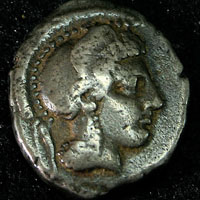
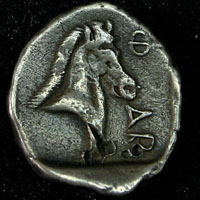
OBV.: Head of Athena with earrings facing right, wearing a crested Attic helmet with raised cheek guards.
REV.: Horse head in incuse square facing right. In right field, inscription "F-AR" with archaic Greek R; test cut on base of horse head.
HFMA nr. 2006.010.007. Ref.: Lavva (2001) nr. 31.
Pharsalos was an important city in the south of ancient Thessaly (map). Not mentioned in Homer's epics, it claimed to be the Homeric Phthia, the birthplace of Achilles. Nowadays, it is best known as the site of the battle of Pharsalos in 48 BCE (immortalized, e.g., in Lucan's epic poem Pharsalia) in which Julius Caesar defeated Pompey and the forces of the Roman Republic.
The coin was minted during the Golden Age of Pharsalos under its ruler Daochos (ca. 441 - 413 BCE). The Attic helmet worn by Athena was relatively impractical in battle since it offers much less protection than the Corinthian helmet, and so it has been suggested that the Athena on the obverse is the city's patron goddess, Athena Polias. The horse head on the reverse alludes to the fact that the Thessalians had the best cavalry and bred the best horses. Alexander the Great's famous horse, Bukephalos, for example, came from Thessaly.
O.K.
Literature:
S. Lavva, Die Münzprägung von Pharsalos. Saarbrücken: Saarbrücker Druckerei und Verlag, 2001. -
Tarsus, Silver Stater, 373/72-369/68 BCE
weight: 10.7g; width: 2.2cm; die axis: 10h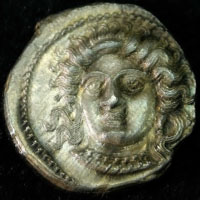
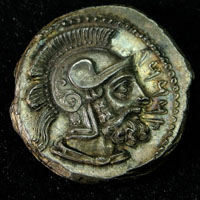
OBV.: Facing head of a goddess or nymph, inclined to left, wearing a sphendone, multipendant necklace, and earrings, all set in dotted border.
REV.: Bearded male head (Ares?) wearing an Attic helmet with three-part crest and movable double visor, facing to the right, set in dotted border. Aramaic inscription in right field: TRKMW, i.e., Tarkamuwa, the Persian satrap known to the Greeks as Datames.
HFMA nr. 2006.010.008. Ref.: Kraay (1976) pp. 201-2.
Datames (ca. 407 - ca. 362 BCE) was satrap (Persian governor) of both Cappadocia and Cilicia under the Persian Great King Artaxerxes II (405-359 BCE). Datames served first in Artaxerxes' palace guard, then proved his loyalty and military talent in several bloody campaigns. He became Artaxerxes' most powerful satrap, ruling all of Eastern Anatolia up to the Black Sea. In the end, however, he led the great Satrapal Revolt against Artaxerxes that took almost a decade to suppress. Datames was assassinated in 362 BCE.Around 378, Pharnabazus, the satrap of Dascylium in Northwest Anatolia, was ordered to prepare an invasion of Egypt, which had temporarily freed itself of Persian rule. When Pharnabazus' attempt to recover Egypt failed in 373 BCE, the command for another, similar invasion was given to Datames.
To pay their armies for these expeditions, both satraps minted near-identical coins, distinguished only by their inscriptions. The reverse of these coins may show a representation of Ares, the Greek god of war. The facing head of an unidentifiable female deity (Aphrodite, the wife of Ares?) on the obverse is clearly influenced by the famous representations of the nymph Arethusa created by the artist Kimon for the coins of Syracuse. Both designs were probably meant to appeal to the thousands of Greek mercenaries that each Persian satrap hired for their Egyptian campaigns.
O.K.
Literature:
Kraay, Colin M., Archaic and Classical Greek Coins. Berkeley; Los Angeles: University of California Press, 1976.
Moysey, R. A., "The Silver Stater Issues of Pharnabazos and Datames from the Mint of Tarsus in Cilicia," The American Numismatic Society Museum Notes 31 (1986) 7-61. -
Silver Siglos, 485-470 BCE
weight: 5.3g; width: 1.6cm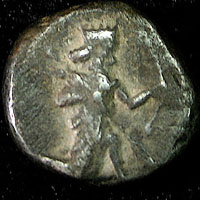
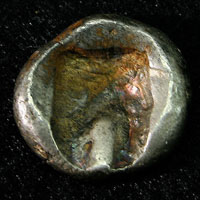
OBV.: Royal archer running right, quiver on back, holding bow in his left and a transverse spear in his right hand.
REV.: Oblong, tooth-shaped incuse mark.HFMA nr. 2006.010.009. Ref.: Carradice (1987) siglos type IIIb group A, pl. xii (cf. obverse nr. 17).
This silver siglos (Persian for shekel) was minted during the reign of Xerxes (486-465 BCE). At that point, Persia was a huge empire that was trying to expand further (map). A first attempt by Darius I to invade Greece had failed in 490 BCE with the battle of Marathon. Xerxes, his son, may well have coined this particular coin to hire mercenaries for his own invasion (481-479 BCE). The design, also used on Achaemenid gold coins (darics), shows a running figure with a bow in his right hand. Accordingly, the Greeks referred to these coins as toxotai (archers). The archer is wearing a long, pleated garment, apparently without sleeves so that he has his arms free to shoot. On his head is the crenellated crown (tiara or kitaris) of the Achaemenid kings. In his left hand, he is holding a long lance that is pointing to the ground. The quiver that belongs to the bow is slung over his shoulders. The figure is presented in the so-called Knielauf scheme (1), i.e., running with one knee bent, that can also be found on the HFMA's coin from Thasos or elsewhere in Greek art in representations of Medusa or Nike. The reverse shows a simple, irregular punch mark.
The archer has variously been interpreted as a representation of the Great King himself, of a 'royal hero', or of a god in special avatar (2). The first reading seems the simplest and most likely explanation, not least because of the figure's dress and acouterments. The crown on the figure's head, for example, corresponds exactly to the type of crown most commonly worn by Achaemenid rulers, a "rigid cylinder with crenellated decoration" (3). The luxurious pleats on the archer's garment are also evidence of court dress (4). The bow and lance belong to the items that each king received at his accension to the throne during a ceremony of investiture, together with his crown and royal robe (5). For this reason, the Achaemenid archer coins probably represent the Great King himself adorned with the symbols of his power: crown, royal dress, bow, and lance. These symbols served as reminders that the king had been installed with the blessings of the supreme god, Ahura Mazda, and thus, they promoted the king's divine support and legitimate claim to his throne (6).
O.K.(1) German Knielauf (pronounced k-NEE-loaf) literally means "knee-running".
(2) See the summary in Alram, Daric.
(3) Calmeyer, Crown. See also the depiction of Darius I hunting on a cylinder seal in the British Museum.
(4) Shapur Shahbazi, Clothing.
(5) Wiesehöfer 2001, 32.
(6) Curtis 2007, 425 makes similar claims for Parthian and Sasanian coins.Literature:
Alram, M. "Daric", Encyclopedia Iranica.
Calmeyer, P., "Crown", Encyclopedia Iranica.
Carradice, I., "The 'Regal' Coinage of the Persian Empire." In: I. Carradice, ed., Coinage and Administration in the Athenian and Persian Empires. Oxford 1987, 73-108
Curtis, V. S., "Religious Iconography on Ancient Iranian Coins." In: Joe Cribb & Georgina Herrmann, edd., After Alexander: Central Asia before Islam (Proceedings of the British Academy, 133), Oxford: Oxford University Press, 2007, pp. 413-434.
Shapur Shahbazi, A. "Clothing", Encyclopedia Iranica.
Wiesehöfer, J., Ancient Persia. From 550 BC to 650 AD, London 2001. -
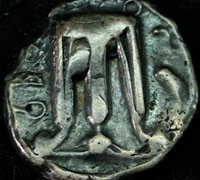
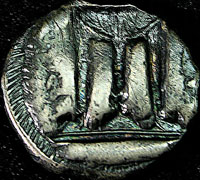
Silver Stater, ca. 530 BCE
weight: 7.8g, width: 1.98cm
OBV.: Tripod-lebes with three handles and lion’s feet; in right field, marsh bird (heron?) facing left. Retrograde inscription in left field "KPW" (= KROTON), with archaic letter koppa; raised dotted border (quite worn).
REV.: Tripod incuse, with incuse border of radiating lines.
HFMA nr. 2006.010.010. Ref.: BMC Italy, p. 343, 15; SNG ANS 238-242, SNG Lloyd 592, and SNG Munich 1421.
Croton (Greek: Kroton) was an Achaian colony on the East coast of Bruttium in Southern Italy, founded around 710 BCE. The coin was minted during Croton's heydays in the late sixth and early fifth century BCE. Croton's athletes, first and foremost the famous wrestler Milon, won numerous victories at the Olympic Games, and the philosopher Pythagoras moved to Croton and opened his school there. In 510 BCE, the Crotoniates, led by Milon, destroyed an important rival, the Italiot Greek city Sybaris, which resulted in an unprecedented period of prosperity and political power for the city.The tripod on the obverse is probably an allusion to Croton's many athletic successes since tripods served as victory prizes at the Olympic Games and other important athletic events. The heron, a marsh bird of good omen, reflects Croton's coastal location. The reverse bears an incuse image that mirrors the design on the obverse, a typical feature of Italiot Greek coins at the time. The inscription on the left is retrograde (mirror-inversed) and features an archaic letter koppa instead of the later Greek kappa.
O.K. -
Silver Tetradrachm, Amphipolis mint, ca. 323-315 BCE
weight: 13.8g, width: 2.19cm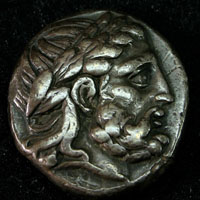
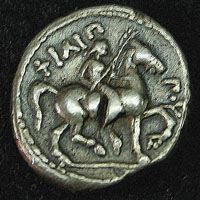
OBV.: In dotted circle, laureate head of Zeus facing right. Counter-mark "X" (Chi) below head.REV.: In dotted circle, naked youth on horse, holding a palm leaf. Inscribed above: "PHILIPPOY" (= "of Philipp"). Dolphin under belly of horse, letter P with dot (= PO?) under raised right fore-hoof; test cut through body of horse.
HFMA nr. 2006.010.011. Ref.: SNG ANS 749, LeRider plate 46, 19.Philipp II of Macedon (359-336) was a ruthless and ambitious politician who first managed to unify Macedon under himself and then started to conquer large swathes of Northern Greece, including important gold-mines in the Pangaeum near Amphipolis, which became one of the principal mint places of Macedon. At the battle of Chaeroneia in 338 BCE, Philipp defeated the forces of Athens and Boeotia, which made him the most powerful man in all of Greece (map). On the eve of his next big project, a Greek invasion of the Persian Empire under his leadership, Philipp was assassinated in 336 BCE.
The Olympian Zeus, depicted on the obverse, had special meaning for Philipp as he used to organize games in honor of Zeus in the southern Macedonian border town of Dion, at the foot of Mt. Olympus, and built a treasury temple called Philippeion in the sacred precinct of Zeus in Olympia on the Peloponnese. Moreover, whereas the other Greeks considered the Macedonians half-barbarians, the Macedonian kings claimed descent from Heracles and thus from Zeus, and this allowed them to compete as Greeks at the Olympic games.
The image on the reverse, a rider on horseback holding a victor's palm branch, promotes another connection of Philipp to Zeus: In 356 BCE, the same year in which his son, Alexander, was born, Philipp won an Olympic victory at the horse races.
O.K. -
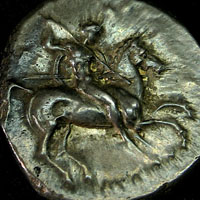
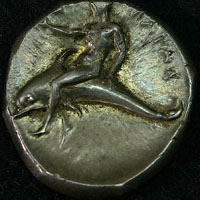
Silver Didrachm, 281-276 BCE
weight: 7.9g, width: 2.05cm
OBV.: Nude warrior on horseback galloping right, carrying round shield and two spare spears in left hand, another spear pointed downwards in right. Remnants of inscriptions left behind rider (SI) and between horse’s legs (LYKWN) (= Lykon, probably the mint master).
REV.: Young heros riding dolphin left; inscription TARAS right.
HFMA nr. 2006.010.012. Ref.: Vlasto 695, SNG ANS 1069, HN Italy 967.
The famous 'horsemen' first appear on Tarentine coins around 450 BCE. Heroically nude on the earliest and many later coins, they probably refer to equestrian games at Tarentum, or they may simply be a representation of the aristocratic spirit of the Tarentines. The military poses of some of these horsemen have also been interpreted as allusions to Tarentum's constant struggles with its neighbors, especially the non-Greek Lucanians and Messapians.
The dolphin rider on the reverse probably represents the mythical Spartan founder, Phalantos. The story went that Phalantos suffered shipwreck near the Tarentine coast and was safely brought to shore by a dolphin. The inscription Taras reflects the city's Greek name, but also the name of a nearby river and the god living in it. Accordingly, the dolphin rider has also been interpreted as the god Taras. Yet in classical Greek art, river deities are usually depicted as half-man, half-bull.
This particular coin originates from the dramatic final phase of the city's independence (1), as evidenced by the unabbreviated signature of the official supervising the minting process, Lykon, and the relatively high weight of this specimen (2). In 282 BCE, a small Roman flotilla on a mission to aid the Greek city of Thurioi north of Tarentum had dared to sail into Tarentum's harbor in violation of an earlier treaty that barred Roman ships from entering the Gulf of Tarentum. The Tarentines responded to this provocation by sinking or capturing half of the ships. Then they went to Thurioi and expelled the Roman garrison there. In the next year, a Roman envoy sent to negotiate was publicly humiliated in the city's theater. Tarentum engaged a famous general, king Pyrrhus of Epirus, for assistance in the ensuing war against the Romans. Pyrrhus defeated the Romans twice, but the second victory, at Asculum in 279 BCE, came at such great cost that he famously remarked, "If we win one more victory against the Romans, we will be completely ruined" (4). Subsequently, Pyrrhus abandoned Southern Italy in favor of Sicily. In the end, Rome won the Pyrrhic War (280-272 BCE) and forced Tarentum to accept a permanent Roman garrison on its acropolis.
O.K.(1) Evan's Period VI, which Fischer-Bossert puts at 281-276 BCE.
(2) The weight of Tarentine didrachms would soon be reduced from around 8.2g to around 6.6g.
(3) Dionysius of Halicarnassus, Antiquitates Romanae 19.5.
(4) Plutarch, Life of Pyrrhus 21.14.
Literature:
Brauer, Jr., G. C., Taras: its History and Coinage. New Rochelle, NY: Caratzas, 1986.
Evans, A. J., "The 'Horsemen' of Tarentum," Numismatic Chronicle n.s. 3, 9 (1881), 1-242.Fischer-Bossert, W. Chronologie der Didrachmenprägung von Tarent, 510-280 v. Chr. Berlin: DeGruyter, 1999.
Ravel, Oscar E., Descriptive Catalogue of the Collection of Tarentine Coins formed by M. P. Vlasto. Chicago: Obol International, 1977. -
Tarsus (Cilicia) mint, Silver Tetradrachm, 333-327 BCE
weight: 16.8g, width: 2.38cm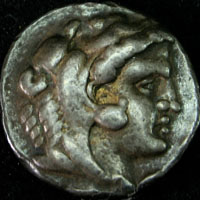
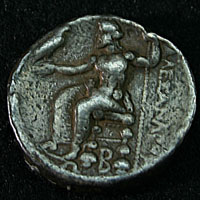
OBV.: Young head of Hercules, wearing lion's skin, facing right.
REV.: Zeus seated on throne with bulbous legs, facing left, feet on footstool. He holds an eagle in his outstretched right hand and a scepter in his left. Inscription ALEXANDROU (= "of Alexander") in right field. Mint mark "B" below throne. HFMA nr. 2006.010.013. Ref.: Price (1991) nr. 3000.The far-flung campaigns of Alexander the Great, the huge empire he built, and the fact that his successors continued to mint Alexander's coins made this kind of tetradrachm the most widely circulating coin of antiquity.The image of a young, beardless Herakles on the obverse, a reference to the direct descent of the Macedonian kings from this most popular Greek hero, is often taken as a portrait of Alexander himself. That, however, is very unlikely. Several earlier Macedonian kings had used the same design of a beardless young Herakles on their coins. The first Hellenistic king to mint coins with his own likeness was Ptolemy I of Egypt, a former general of Alexander.
On the reverse, the coin shows Zeus, the ruler of the Greek pantheon and a fitting symbol for kingship. A head of Zeus, for example, graced the obverse of the coins of Philipp II of Macedon, Alexander's father. What is unusual about the enthroned Zeus on Alexander's tetradrachms, however, is the kind of throne he sits on. A number of scholars argue that the shape of the throne's legs, in particular, is distinctly Persian. A similar depiction of an enthroned Baal of Tarsus holding an eagle had been used on the reverse of silver coins produced in Tarsus by the Persian satrap Mazaios right before Alexander conquered the city in September 333 BCE. Accordingly, some scholars believe that Alexander started his iconic silver coinage far from home in Tarsus, probably using the same artisans that cut the dies for Mazaios' coins.
If this is true, this would not only mean that Alexander waited three years after his ascension to the throne to mint his own coinage. It also means that the god on the reverse may have been read very differently, depending on the audience. Alexander's Greek soldiers probably interpreted the throning deity as their familiar Zeus, whereas the natives may have understood it as the Baal of Tarsus and may have appreciated the Greek king's apparent respect for their local god.
O.K.
Literature:
Price, M., The Coinage in the Name of Alexander the Great and Philip Arrhidaeus: A British Museum Catalogue. Zürich: Swiss Numismatic Society/London: British Museum Press, 1991. -
Silver Drachm, ca. 350 BCE
weight: 5.1g, width: 1.73cm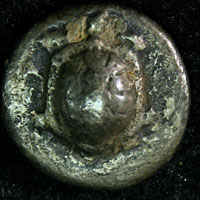
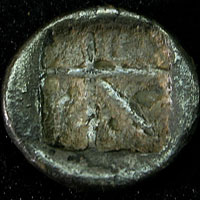
OBV.: Land turtle, head turned right, seen from above, flanked by the initials of AIGINA, the letter "alpha" on its left, "iota" on the right.REV.: Five-part incuse square with thin, partly rectilinear bands; remnants of letters (?) in upper two divisions, of a dolphin in lower rectangular division.
HFMA nr. 2006.010.014. Ref.: Kraay (1976) nr. 138.From the seventh to the fifth century BCE, Aegina, an island in the Saronic Gulf, 17 miles (30km) west of Athens, was a great naval power. It contributed the third-largest contingent of ships to the Greek fleet that defeated the Persians at Salamis in 480 BCE. Its trade connections reached all over the Mediterranean. Its harbor was a distribution center for wheat from the Black Sea, and Aegina was one of the first three Greek states that was allowed to run a trading post in Naucratis, Egypt's most important seaport.
Aegina was also the first state in Greece proper to mint coins, starting around 580 BCE. The design changed little over the centuries: The obverse always showed the badge of the city, first a sea turtle, later a land turtle or tortoise; the reason for this change is unknown. The reverse was marked with a simple windmill-shaped incuse pattern. Not surprisingly, the nickname for these coins was chelonai (turtles). Up to the Peloponnesian War, the chelonai were the only universally accepted coinage in the Peloponnese, and the Aeginetan weight standard was adopted even in Northern Greece and parts of Asia Minor. In fact, Aegina's money was so well-known that it gave rise to a proverb: "Virtue and wisdom are vanquished by turtles."
In 458 BCE, Athens subdued its old rival, Aegina. In 431 BCE, the first year of the Peloponnesian War, the Athenians expelled the inhabitants and distributed their land among Athenian settlers. The Aeginetans, who had been resettled by the Spartans, could only return after Athens was defeated in 404 BCE. They celebrated the liberation of their island by issuing coins, such as our specimen, that again showed the traditional tortoise. Only the incuse pattern was slightly different: the lines of the windmill pattern are now thinner, and the different fields contain symbols like a dolphin and the letters AIG or the initials of the magistrates supervising the minting process.
O.K.
Literature:Kraay, Colin M., Archaic and Classical Greek Coins. Berkeley; Los Angeles: University of California Press, 1976. -
Silver Diobol, 325-300 BCE
weight: 1.2g, width: 1.06cm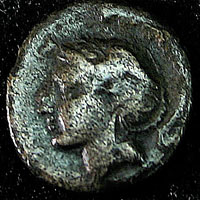
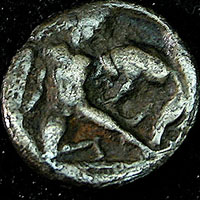
OBV.: Head of Athena, facing left, wearing a crested Attic helmet decorated with olive wreath and wing.
REV.: Hercules, kneeling on his right leg, left leg extended, a club in his right arm, is fighting off the Nemean Lion that is attacking him from the right.
HFMA nr. 2006.010.015. Ref.: Vlasto 1364; SNG UK Vol. III 283 Lockett Collection; SNG UK vol. VIII 53 Blackburn Museum.
Tarentum (Greek: Taras), a city in the instep of the Italian peninsula, was the richest and most powerful Greek city in Italy. The only colony founded by Spartans, Tarentum alone possessed a safe harbor on that stretch of coast, and it was famous for the fine textiles and the precious deep red dye, derived from murex shells, that were produced and exported by the city.
Around 380 BCE, Tarentum became the leading member of a confederation of Italiot Greek cities seated in Heraclea and formed to battle the surrounding non-Greek tribes. Other members were Elea, Croton, Thurioi, and Metapontum. This diobol is an example of the league's common coinage, which imitated the design of Heraclean coins. Heraclea adopted the head of Athena on the obverse from Thurioi which, together with Tarentum, founded the city in 433 BCE. On the reverse, Herakles, Heraclea's patron heros, is represented in the midst of his first and most famous labor, the fight against the Nemean lion. The lion could not be killed with any kind of weapon so that Herakles had to strangle him with his bare hands. Nevertheless, the hero's right hand seems about to hit the lion with his characteristic club while his left is trying to fend off the beast.
O.K.
Literature:
Brauer, Jr., G. C., Taras: its History and Coinage. New Rochelle, NY: Caratzas, 1986, pp. 55-56.
Ravel, Oscar E., Descriptive Catalogue of the Collection of Tarentine Coins formed by M. P. Vlasto. Chicago: Obol International, 1977. -
Silver Tetradrachm, 470-466 BCE
weight: 16.3g, width: 2.66cm
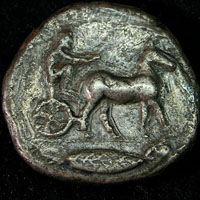
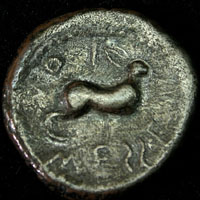
OBV.: Seated charioteer, bent forward with long arms, driving an apene, a race chariot drawn by two mules, to the right. Large laurel leave in exergue; all set in dotted border.
REV.: In dotted border, hare jumping right. Inscription "MESSE-N-ION" (of the Messenians) with small Omikron.
HFMA nr. 2006.010.016. Ref.: SNG ANS 317; Caltabiano Series IV, cf. obverse of Nr. 145 (D 89).
The city of Messana (today Messina) in Sicily, across from the tip of the Italian peninsula, was originally named Zancle (“Sickle”), a reference to the shape of its harbor. Its name was changed to Messana when Anaxilas (died 476 BCE), the tyrant of Rhegium, a city on the Italic peninsula just across the strait from Messana, conquered Zankle in the early 5th century BCE and settled Messenian exiles there (Messana is the Doric dialect version of Messene, a region on the Peloponnese that was dominated by Sparta).
The charioteer on the obverse sits on a low chariot drawn by two mules, a so-called apene. Apene races were first held at the Olympic Games in 500 BCE, but abolished as early as 444 BCE because they were considered not dignified enough. Anaxilas, however, was so proud of his Olympic victory with the apene that he commemorated it with this coin type, first struck in 480 BCE. The design became so firmly associated with Messana that the Messenians kept it even after Anaxilas’ death in 476 BCE and the expulsion of his successors in 461 BCE.
The olive leaf in the exergue, the area below the chariot, represents the olive crown that was awarded to victors at the Olympic Games (1).
The hare on the reverse may symbolize the speed of Anaxilas’ chariot, or it may haven been chosen for its association with fertility and abundance (2). Aristotle (quoted by Pollux, Onomasticon 5.75) also claims that Anaxilas introduced the hare to Sicily, probably because hare hunts were a favorite aristocratic pastime.
O.K.
(1) Caccamo Caltabiano (1993: 35-36) interprets the leaf as a laurel leaf, sacred to Apollo and takes it as a sign that the charioteer represents a deity of solar character, since Phoibos Apollo is (albeit in later times) often identified with the sun. Some of the leaves on the Messana coins, however, clearly have a berry attached, and that would support their identification as olive leaves.
(2) Caccamo Caltabiano (1993: 39-40) prefers the latter interpretation, but she also mentions that there are other ancient representations in which a hare appears between the feet of chariot horses to symbolize their speed.
Literature:
Caccamo Caltabiano, Maria, La monetazione di Messana (Antike Münzen und geschnittene Steine, 13). Berlin: DeGruyter, 1993. -
Unknown ruler, Silver Drachm, 190-164 BCE
weight: 3.9g; width: 1.69cm; die axis: 4h
OBV.: In dotted border, head of ruler right, with close-cropped beard, a circular earring, and a flat kyrbasia (Persian crown) bound with a ruler's diadem which is tied in the back. On top of the kyrbasia stands a royal falcon in frontal view with outstretched wings.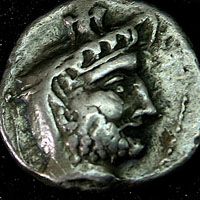
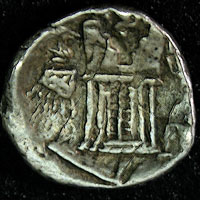
REV.: Fire altar (overstruck) with double-paneled doors, podium, pilaster, and architrave, surmounted by stepped gables. Between the gables, a Farnah (king's splendor) hovering right. The altar is framed by a falcon standard on the left and a barely visible ruler in adoring position with upraised arms on the right.
HFMA nr. 2006.010.017. Ref.: Cf. Alram 1986, p. 170, nr. 550 (but the king is also holding a bow); cf. also [but with mirror-inverted reverses] BMC Arabia pl. XXX, 2-7 (there as "Darius (?)"); tetradrachm SMBerlin Nr. 18208603. (more info).
Persis, a region north of the Persian Gulf in what would now be Southern Iran, was the original home of the ancient Persians. Since Alexander the Great's death in 323 BCE, the region had been part of the Seleucid empire. This coin, however, must have been minted during the short period when Persis was basically independent, between the battle of Magnesia (190 BCE), which decisively weakened Seleucid power in the region, and the occupation of Persis by the new Parthian empire in 140 BCE.(1)
The ruler depicted has been identified as Vadahfrad II (Autophradates II), but this is based on a barely legible Aramaic inscription on a coin of similar type that has been read both as wtprdt (Vadahfrad) and šykndt (an Iranian transcription of Alexandros?).(2)The coin displays an interesting mixture of Hellenistic Greek and native Persian iconography. The obverse features a portrait of the ruler not unlike the coins of the area's former Greek overlords, the Seleucid kings. The ruler, however, wears not only a diadem, like the Greek Hellenistic kings, but also a flat Persian crown (a kyrbasia). His crown is adorned on top with the Zoroastrian royal bird, the falcon, facing the viewer with outstretched wings.(3)The reverse design similarly emphasizes the indigenous, Persian nature of the monarchy. In the middle stands a Zoroastrian fire altar with stepped gables. Between the gables is a representation of a Zoroastrian Farnah, facing right.(4) The Farnah is a personification of a king's "lucky splendor", which represents the protection by his deified predecessors that a legitimate ruler enjoys. The left displays the royal standard with a falcon perching on top, to the right one can barely make out the arms of the ruler who looks at the altar and has raised his arms in prayer. The entire scene proclaims the divine legitimacy of the king's rule. The same scene reappears almost unchanged on all coins of Persis for ca. 200 years.
Our coin seems to be unusual in that the reverse is mirror-inverted in comparison with all other coins I have seen so far. Moreover, the reverse design is somewhat obscured by the fact that the coin was overstruck onto a coin with the same, but differently aligned reverse design.
O.K.
(1) Müseler 2005-2006, 100.
(2) Müseler 2005-2006, 98-99.
(3) Cf. Curtis 2007; elsewhere, the bird is usually described as an eagle.
(4) Müseler 2005-2006, 96; Curtis 2007; Alram 1986, 170 interprets the being as Ahura Mazdah, the supreme god of the Zoroastrians.
Literature:
Alram, Michael, "Nomina Propria Iranica in Nummis. Materialgrundlagen zu den iranischen Personennamen auf antiken Münzen." In: Mayrhofer, Manfred (ed.), Iranisches Personennamenbuch, vol. 4 (Sonderpublikation der Iranischen Kommission). Vienna: Verlag der Österreichischen Akademie, 1986.
Curtis, Vesta Sarkhosh, "Religious Iconography on Ancient Iranian Coins." In: Cribb, Joe and Herrmann, Georgina (edd.), After Alexander: Central Asia before Islam (Proceedings of the British Academy, 133), Oxford: Oxford University Press, 2007, pp. 413-434.
Müseler, W. "Die sogenannten dunklen Jahrhunderte der Persis: Anmerkungen zu einem lange vernachlässigten Thema," Jahrbuch für Numismatik und Geldgeschichte 55/56 (2005/2006) 75-103. -
Ptolemy IX Soter II (first reign 116-107 BCE), Silver Tetradrachm, 110/09 BCE
weight: 14.2g; width: 2.45cm; die axis: 11h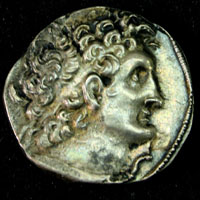
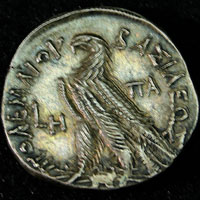
OBV.: Head of Ptolemy I Soter (305-285 BCE) wearing diadem and aegis right, set in dotted border.
REV.: Eagle sitting on a fulmen (winged thunderbolt of Zeus). Inscription above: "PTOLEMAIOU BASILEWS” (= Ptolemaiou Basileos, "of King Ptolemy). In left field, L and year "H" (8. year = 110/09 BCE). Mint mark on right: "PA" (= Alexandria).
HFMA nr. 2006.010.018. Ref.: BMC Ptolemies p.108 nr. 59-60 [plate xxvii.1]; Svoronos 1669 (attributed incorrectly only to Ptolemy X and Paphos); SNG Copenhagen 352; Nicolaou/ Mørkholm 1976, 91 (nr. 822-869, cf. plate XXI, 825).
This coin was minted during an especially eventful and troublesome period in the history of the later Ptolemaic Empire. When Ptolemy VIII Euergetes died, he declared his wife, Cleopatra III, ruler together with whomever of her two sons she should choose as co-ruler (1). Cleopatra's first choice was her younger and thus presumably more pliable son, Ptolemy Alexander, but the inhabitants of the capital, Alexandria, refused to accept him. In the face of revolt, she had to install her older son, then about 25 and for some reason nicknamed Lathyros ('chickpea'), as Ptolemy IX Soter II.
In the following years, Cleopatra repeatedly shuffled her sons between the posts of co-ruler of Egypt and king of Cyprus. In 107 BCE, Cleopatra successfully persuaded the people of Alexandria that Ptolemy Lathyros was trying to kill her. Ptolemy IX was driven out of Egypt, and his younger brother, Ptolemy X Alexander II, was installed as his mother's co-ruler. Their common coins showed now not only Ptolemy Alexander's, but also his mother's regnal years. Ptolemy Soter fled to Cyprus and became king there.
In 101 BCE, Cleopatra again tried to exchange one brother for the other. This time, Ptolemy Alexander, now grown up, murdered her, and Soter remained in Cyprus. Only in 88 BCE, when the Alexandrians rebelled against his younger brother, could Ptolemy IX Soter II return and resume the throne again. His brother was killed at sea, trying to invade Cyprus, and so Ptolemy Soter was able to rule undisturbed for another 7 years, until he died in December 81 BCE.The Greek letter Eta (H) on the reverse of this coin dates it to the eighth year of Ptolemy IX's rule (110/09 BCE), two years before he was driven into exile. The mint mark PA often stands for Paphos on Cyprus but the style clearly distinguishes this coin from those his brother minted simultaneously on Cyprus and shows that this coin was issued in Alexandria (2). In contrast to a few of his predecessors, Ptolemy IX Soter II chose not to mint coins with his own portrait. Instead, they feature again the founder of the dynasty and his namesake, Ptolemy I Soter (305-285 BCE), and the standard Ptolemaic reverse design, the eagle of Zeus as a symbol of legitimate kingship. The coin thus seems a more than transparent attempt to promote the continued stability of Ptolemaic rule in the face of the actual discord within the royal house.
(1) Eusebius, Chronica 1.163 (ed. Schoene).
(2) Nicolaou/ Mørkholm 1976, 94.
O.K.
Literature:
Hölbl, Günther, A History of the Ptolemaic Empire, London: Routledge, 2001.
Mørkholm, Otto, "The last Ptolemaic silver coinage in Cyprus," Chiron 13 (1983), pp. 69–79.
Nicolaou, Ino and Mørkholm, Otto, Paphos I: A Ptolemaic Coin Hoard. Nicosia, 1976. -
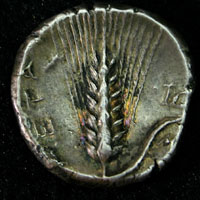
Silver Stater, ca. 325-300 BCE
weight: 7.7g, width: 2.15cm; die axis: 2h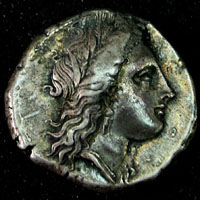
OBV.: Head of Demeter, wearing necklace and triple-pendant earring and crowned by a wreath of three barley ears and two pairs of leaves, facing right. Signature under chin: “DA(I)”.
REV.: Seven-grained ear of barley in center with a leaf curving to the right. Above the leaf is a small plow, below it part of the mint supervisor's mark, “M(AX)”. In left field, inscription "META," abbreviation for METAPONTIWN (= Metapontion, "of the Metapontians"). There is a die flaw in the upper left awns of the ear of barley.
HFMA nr. 2006.010.019. Ref.: Johnston C1, SNG ANS 467ff; SNG UK Vol. III 425.
Metapontum (Greek: Metapontion) was an Achaean colony on the instep of the Italian peninsula, ca. 30 miles west of Tarentum (map). The city was located in a fertile plain between two rivers. At some point, the city grew so rich from farming that it sent a "golden harvest" to Delphi (1), probably in the form of a golden sheaf of barley, the city badge. The city also had its own treasury house in Olympia, another sign of its wealth and importance. When the aged Pythagoras and his pupils were driven out of Croton, he found refuge in Metapontum, where he died around 497/96 BCE. Cicero visited his grave there (2).
Starting in the fifth century, all coins of Metapontum show the city badge, an ear of barley, on the reverse. The obverse frequently depicts a head of Demeter, the goddess of agriculture and grain. The female head on this particular coin may imitate the famous Arethusa heads carved by the engraver Euainetos on Syracusan coins from the late fifth century.
O.K.
(1) Strabo 6.264. (2) Cicero, De finibus 5.4.
Literature:
Johnston, Ann. The Coinage of Metapontum, Part 3. New York: American Numismatic Society, 1990 (Numismatic Notes and Monographs, 164). -
Silver Didrachm, 400-330 BCE
weight: 7.6g, width: 2.19cm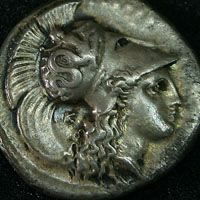
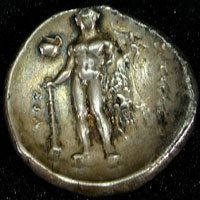
OBV.: Athena in a Corinthian war helmet decorated with crest and Skylla throwing stone. Above helmet worn inscription: “HRAKLHIWN” (Herakleion = of the Herakleians). Just behind the curve of the lowest plume is the engraver’s mark "K" .
REV.: Herakles standing naked, facing forward. His left arm is leaning on a club. Floating at his left shoulder is a wine jug (oinochoe). Spread across his right arm is his lion pelt; in his hand he holds a bow and arrow. Remnants of inscription “HRAKLHION” (Herakleion = of the Herakleians) in right field. Inscription beside the club: "AQA" (= Atha...).
HFMA nr. 2006.010.020. Ref.: SNG UK Vol. III 346 Lockett Collection; BMC 33; Sear # 391.
Heraclea (Greek: Herakleia) on the instep of the Italian peninsula was founded as an outpost against the non-Greek Lucanians by an alliance of Tarentum and Thurii in 433 BCE near the destroyed city of Siris. It became famous as the site of the first major battle of the Pyrrhic War in 280 BCE in which king Pyrrhus of Epirus defeated a Roman army on the head of a coalition of Southern Italian Greek city states.
Heraclea's coinage echoes the circumstances of its foundation. The Athena on the obverse is taken from Thurii, which was itself a colony of Athens. The female sea monster or Skylla on the goddess' helmet, which was also already present on Thurian coins, may be a reference to the cult of Athena Skyletria. The Skylla is probably a pun on the Greek word skyla (war booty) and points to Athena's nature as a deity bringing victory and booty (1).
The Doric hero Herakles on the reverse recalls Tarentum, a city founded by Dorians from Sparta.
O.K.
(1) Lavva 2001, 26.
Literature:
N. Davis, Greek Coins and Cities. Seattle: Seattle Art Museum, 1967, p. 178.
S. Lavva, Die Münzprägung von Pharsalos. Saarbrücken: Saarbrücker Druckerei und Verlag, 2001. -
Demetrios II Nikator, First Reign, Silver Tetradrachm, Seleucia on the Tigris mint, 145-141 BCE
weight: 14.9g; width: 2.66cm; die axis: 1h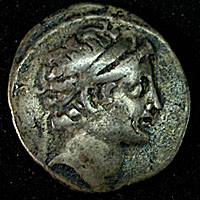
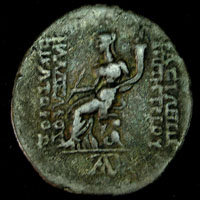
OBV.: In fillet border, diademed head of Demetrios II right.
REV.: Tyche seated on backless throne, cradling a cornucopia in her left arm, holding a scepter in her right hand. The right leg of the throne has the form of a winged Tritoness (snake-bodied nymph). On right side of throne is inscribed "BASILEWS DHMHTRIOY" (= Basileos Demetriou, "of king Demetrios", on the left side "FILADELFOY NIKATOPOS" (= Philadelphou Nikatoros, "friend of his sibling, victor." AYT monogram in exergue.
HFMA nr. 2006.010.021. Ref.: SNG Spaer 1752; Houghton, CSE 1010 = SNG Lockett 3151, LeRider Suse, pl. XXIX.
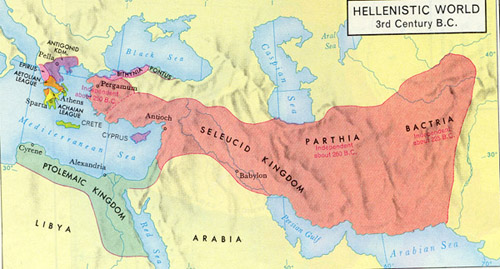
By the time of Demetrios II Nikator, the once vast Seleucid Empire consisted of little more than Syria (encompassing today's Syria, Lebanon, northern Israel, and a small stretch of the southern coast of Turkey). Yet even this reduced realm was heavily contested.
In order to succeed his father on the throne, Demetrios first had to remove the usurper, Alexander I Balas, who had defeated and killed his father, Demetrios I Soter (162-150 BCE). Demetrios II succeeded in 145 BCE after Ptolemy VI of Egypt changed alliances and gave his daughter, Cleopatra Thea, who had been married to Alexander Balas, instead to Demetrios.
Another usurper arose at once: one of Alexander's officers, Diodotos Tryphon, first installed Alexander's young son as king Antiochus VI, then killed the child and declared himself king. Unable to gain the upper hand, Demetrios decided to embark on a new enterprise, a campaign against the Parthians under Mithradates I who had invaded Seleucid Mesopotamia. Yet in 138, the Parthians captured him. After nine years, when his younger brother, Antiochos VII, who had succeeded Demetrius as king and defeated Tryphon, marched into Parthia, the Parthians released Demetrios to cause problems for Antiochos. Instead, Antiochos died in battle, and Demetrios could resume his rule for another three years (129-126 BCE). He now attempted to conquer Egypt, but failed, and was finally murdered in Tyre.
The head of Demetrios on the coins from his first reign (145-138 BCE) reflects the fact that he was only between 14 and 16 years of age when he ascended to the throne. The reverse touts him, inter alia, as Nikator ("victor"), to promote his victory over the usurper Alexander Balas. The goddess Tyche, the guarantor of fortune and prosperity, appears frequently on Seleucid coins; the founder of the dynasty, Seleucus I Nikator (king from 305-281 BCE), had erected a temple to Tyche in his capital, Antioch-on-the-Orontes, that displayed a famous bronze statue of the goddess by the sculptor Eutychides (a smaller marble copy is now in the Vatican Museum).
This particular coin, minted in the administrative center for Seleucid Mesopotamia, Seleucia-on-the-Tigris, must have been produced before July 141 BCE, when the Parthians conquered this city and nearby Babylon (1).
O.K.
(1) For the date, see Hoover, Antiochos VII.
Literature:
Grainger, John D. A Seleukid Prosopography and Gazetteer. Leiden: Brill, 1997.
Hoover, Oliver D. Seleucid Genealogies and Biographies. -
Thessalian League (Roman Province of Macedonia), Silver Drachma, 168-100 BCE
weight: 3.9g; width: 1.88cm; die axis: 3h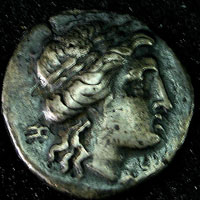
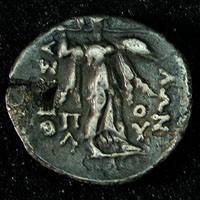
OBV.: Laureate head of Apollo right, letter H left of neck.
REV.: Athena Itonia, advancing right with raised spear and shield. Inscription "QESSA-LWN" (Thessalon = of the Thessalians). Magistrate signature left and right of Athena's legs: "POLY". Most likely minted in Larissa.
HFMA nr. 2006.010.023. Ref.: SNG UK vol. IV 2482 (same mint mark), cf. SNG Cop 300.
The Thessalian league was a loose confederation of Thessalian city states (map). After the Second Macedonian War (200-197 BCE), the victorious Roman general T. Quinctius Flamininus declared all of Greece "free". Consequently, he reorganized the Thessalian league, creating a federal council, the synedrion, and annually changing officers, strategoi. The seat of the league was in the largest Thessalian city, Larisa, and it continued to exist even after Thessaly became part of the new Roman province of Macedonia in 146 BCE.
The Apollo head on the obverse reflects Thessaly's long-standing involvement in the Delphic Amphictyony, an association of Greek states that administered and protected the temple and oracle of Apollo at Delphi.
The reverse features the patron deity of Thessaly, Athena Itonia, whose sanctuary was located between Larisa Kremaste and Pherae. The image probably represents the cult statue of the goddess. Athena is depicted as an Athena Promachos (the Forefighter), advancing in full armor with spear and shield. The fringed object hanging down from Athena's shoulders is her aegis, originally a shaggy, tasseled goatskin that could be used like a shield by wrapping it around the left arm. In later representations, the goddess usually wears it draped around her neck, as here. A hole was drilled into the coin in antiquity so that it could be worn as an amulet on a necklace.
Literature:
Helly, Bruno. "Les émissions monétaires de la Confédératon Thessalienne (IIe-Ier s. av. J.-C.)". In: T. Hackens, G. Depeyrot and Ghislane Moucharte, edd. Rythmes de la production monétaire de l'Antiquité à nos jours. Actes du colloque organisé à la Monnaie de Paris, 10-12 janvier 1986, par le Séminaire de numismatique Marcel Hoc, la Monnaie de Paris et le CNRS (Publications d'archéologie et d'histoire de l'art de l'UCL, L = Numismatica Lovaniensia, 7), Louvain-la-Neuve, 1987, pp. 39-53. -
Silver Drachm, 535-510 BCE
weight: 3.8g, width: 1.6cm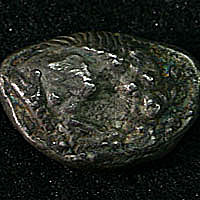
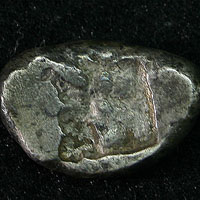
OBV.: Forepart of a lion right with frontal head seen from above, tearing at a stag’s leg.
REV.: Incuse broken square without dividing lines.
HFMA nr. 2006.010.024. Ref.: Williams 11 or 13; Rosen 20; SNG ANS 1202-1204.
Velia (Greek Hyele or Elea) on the western coast of Lucania (map) was settled by Greeks from Phocaea in Asia Minor who left when the Persians under Cyrus conquered the Ionian coast. Elea is best known as the seat of the Eleatic school of Philosophy. Its most famous representatives were Xenophanes (ca. 570-465), its founder, and Parmenides (early 5th cent. BCE).
The near-eastern lion design on the earliest coinage of Velia points to the original home of its first settlers. The lion is portrayed in a strange combination of profile and bird's eye view. The leg and shoulder are those of a lion in profile, whereas the head is shown from above, as if the lion was crouching.O.K.
Literature:
Williams, Roderick T., The Silver Coinage of Velia. London: Royal Numismatic Society, 1992. -
Pergamon (free city in Roman Asia), Silver Cistophoric Tetradrachm, ca. 92-88 BCE
weight: 12.4g; width: 2.68cm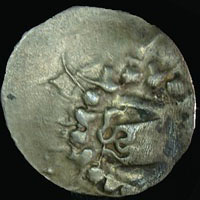
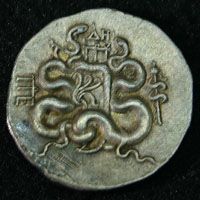
OBV.: Serpent emerging from the half-open lid of a cista mystica, surrounded by ivy wreath; design worn and off-center.
REV.: Two serpents entwined around a gorytos (bow case) that is decorated with an aplustre (a curved decoration at an ancient ship's stern). Monogram PER (= Pergamon) on left; on top DH [delta eta, initials of mint official] above monogram PRY [for Prytanis, title of the magistrate]; in right field, thyrsos entwined by serpent.
HFMA nr. 2006.010.027. Ref.: Pinder 106; Kleiner 31; cf. SNG ANS 1944.100.37465 and 1984.5.54.
The cistophori (basket bearers) were the chief currency in Asia Minor for about 300 years. Originally introduced by king Eumenes II of Pergamon around 166 BCE, the obverse of these coins shows a cista mystica, i.e., a woven basket containing the sacred objects of a mystery cult. In the case of the cistophori, the basket contains snakes associated with the worship of Dionysos. The ivy wreath and the thyrsos staff on the reverse are also references to this god whom the Attalid kings of Pergamon claimed as their ancestor. The bow case (gorytos) on the reverse points to Herakles, the father of Telephos, the legendary founder and first king of Pergamon.When the last Attalid king, Attalos III, died in 133 BCE, he left his entire kingdom to the Roman people. At the same time, his last will declared Pergamon and the other important cities of his realm "free cities", which meant that they did not have to pay tribute to Rome. Not surprisingly, Pergamon and the other cities continued to mint cistophori in grateful tribute to their former ruler.
Under the Attalids, Pergamon was not only the capital of an empire that soon stretched over most of Asia Minor, but also the seat of the second most famous library of the ancient world with more than 200,000 book rolls. When the kings of Egypt, the Ptolemies, whose capital, Alexandria, boasted the only comparable library, cut off Pergamene access to papyrus, the most important writing material, the Pergamenes invented pergamentum, i.e., parchment or vellum made from animal skins.
O.K. -
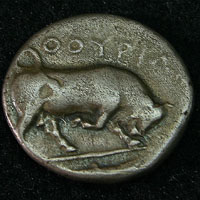
Silver Stater, 400-350 BCE
weight: 7.5g; width: 1.99cm; die axis: 5h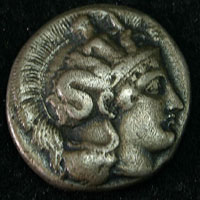
OBV.: Head of Athena, wearing a crested Attic helmet adorned with a Skylla who is shading her eyes.
REV.: A bull pawing the ground, facing right, head down. "THOYPIWN" (Thurion, = "of the Thurians) inscribed above. Mullet-fish swimming right in exergue.
HFMA nr. 2006.010.028. Ref.: cf. Kraay (1976) p. 184 [nr. 731].
Thurii (Greek Thourioi) on the Gulf of Tarentum (map) was an Athenian colony, founded at the initiative of Perikles in 443 BCE at the site of the destroyed city of Sybaris. Among the first colonists were the historian Herodotus and the sophist Protagoras of Abdera who was commissioned to write the new city's code of law. Thurii rose quickly to importance as a rival to Tarentum. By way of compromise, both cities together founded a new colony, Heraclea, in contested territory in 432 BCE.
The coins of Thurii reflect the circumstances of its foundation. The head of Athena on the obverse is a reminder of its Athenian roots. The female sea-monster on the helmet, a Skylla, is shading her eyes to look out for skyla, "loot".
The bull on the reverse was the city badge of Sybaris, on whose ruins the new city was built, and had appeared on the reverse of Sybarite coins. The Thurian bull looks a lot more aggressive, though. Its new stance may be another pun because the Greek adjective thourios means "rushing". Since river gods were often represented with bull features, both the bull and the mullet, a fish that likes brackish water and was considered a delicacy, may be a reference to the nearby river Krathis.
O.K.
Literature:
Kraay, Colin M., Archaic and classical Greek coins. Berkeley; Los Angeles: University of California Press, 1976.
Museum of Fine Arts, Boston. A Guide to the Catherine Page Perkins Collection of Greek and Roman Coins. Boston: Houghton, Mifflin, 1902, p. 13. -
Antiochia on the Orontes (autonomous city in Roman Syria), Bronze Unit (large denomination), 64-49 BCE
weight: 8.3g; width: 1.94cm; die axis: 2h
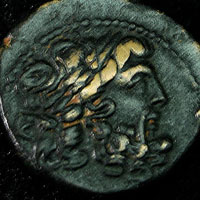
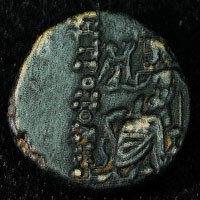
OBV.: In dotted circle, laureate head of bearded Zeus right.
REV.: Enthroned Zeus Nikephoros, i.e., Zeus holding a winged Nike in his right hand, in his left a sceptre. Off-centered so that the right inscription (ANTIOXEWN THS) is missing; inscription left: (M)HTROPOL(EWS) (= Antiocheon tes metropoleos, "of the metropolis of the Antiocheans"). In left field next to leg: cornucopiae. Pompeian Era date in exergue off the flan.
HFMA nr. 2006.010.029. Ref.: RPC 4201-15, cf. image RPC 4212 (but w/o cornucopiae); BMC Syria p. 155, nr. 32 [cf. image BMC 34, plate xix.1].
Antiochia on the river Orontes, today Antakya in Turkey, was founded by Seleucus I Nicator in honor of his father Antiochus. It became the capital of the western part of the Seleucid empire and one of its premier mints. During its peak, Antioch reached a population of 500,000 and was the third-largest city in the Roman empire.
When Pompey reorganized the Near-East and created the Roman province of Syria in 64 BCE, Antioch, which had rebelled against the last Seleucid king, Antiochus XIII, became a free city and continued to issue its own coins.
Both sides of this coin serve as a reminder of the city's Seleucid heritage. A head of Zeus appears already on the obverse of a tetradrachm of Seleucus I (312-280 BCE). A representation of Zeus Nikephoros ("Bearer of Victory") was introduced on the reverse of Seleucid coins by Antiochus IV (175-164 BCE) when he installed a copy of the famous chryselephantine statue of the Zeus of Olympia in the temple of Apollo in Daphne, a suburb of Antioch, in celebration of his victory over Egypt in 167 BCE.
In addition, the image of Zeus alludes to the special circumstances surrounding the city's foundation. According to legend, Seleucus founded the city at the site where an eagle, the bird of Zeus, dropped a piece of sacrificial meat.
O.K.
Literature:
Burnett, Andrew M., Amandry, Michel, and Ripollès, Pere Paul, Roman Provincial Coinage Volume I. From the death of Caesar to the death of Vitellius. London: British Museum Press, 1998.
Butcher, Kevin. Coinage in Roman Syria: northern Syria, 64 BC - AD 253. London: Royal Numismatic Society, 2004. -
Agathokles (317-289 BCE), Bronze Litra, Period 4, ca. 295 BCE
weight: 8.3g, width: 1.97cm; die axis: 10h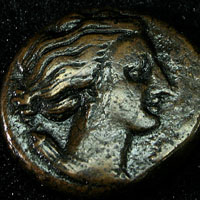
OBV.: Head of Artemis, in profile facing right, hair bound in a ponytail-cum-bun, with triple-pendant earring and necklace, quiver over shoulder. On the right, corroded inscription SWTEIRA (Soteira = "the (female) savior").
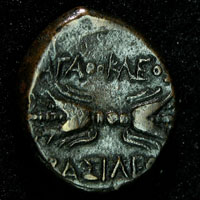
REV.: Fulmen (winged thunderbolt of Zeus) in center. Inscription on top: "AGAQOKLEOS" (Agathokleos = "of Agathokles"), on bottom: "BASILEW(S)" (basileos = "of the king").
HFMA nr. 2006.010.030. Ref.: BMC 422; SNG ANS 708; SNG Cop 779; Calciati II, p. 277, nr. 142.
Agathokles (361-289 BCE), the son of a wealthy manufacturer of ceramics, made himself king of Syracuse and ruled at some point over much of East Sicily and parts of the Italian mainland.
Agathokles showed his military talent early on under Timoleon, who led the Syracusan army against the Carthaginians in West Sicily, and later, when he had been forced into exile by Syracuse's oligarchs, as a mercenary general in the service of Greek Italiot cities.
Around 322 BCE, a new democratic regime in Syracuse recalled him, and Agathokles was elected General and Protector of the Peace. In 317, he staged a coup d'état and made himself tyrant of Syracuse. When he tried to extend his rule over other Greek cities in Sicily, they persuaded the Sicilian Carthaginians to lay siege to Syracuse. In a bold move, Agathokles set over to North Africa and attacked Carthage itself while his brother, Antandros, managed to repel the Carthaginian army from the gates of Syracuse. Yet when Agathokles tried to bring his army back from Africa, the mercenaries dispersed, and he finally had to agree to the peace treaty of 306 BCE that reconfirmed the river Halykos, the previous border, as the limit of Greek influence.
In 304, Agathokles proclaimed himself king (basileus), but when his son and intended successor, also named Agathokles, was assassinated in 289, shortly before his own death from illness, he tried to restore the Syracusan democracy.
The obverse of the coin declares Artemis, the patron goddess of Syracuse, who had an ancient temple on the island of Ortygia in Syracuse's harbor, the savior from the Carthaginian siege. Artemis is characterized as the virgin goddess of the hunt by means of the quiver on her shoulder and through her hairdo, a ponytail-cum-bun, which was typically worn by virgins (1). The reverse shows the thunderbolt of Zeus, a symbol of kingship.O.K.
(1) Neils 2004: 75.
Literature:
Calciati, Romolo. Corpus Nummorum Siculorum. La Monetazione di Bronzo: Vol. 2 (Area IV) Syracuse, Milan: Mortara, 1986.
Consolo Langher, Sebastiana Nerina, "Il messaggio monarchico sulle monete di Agatocle." In: Actes of the 11th International Congress of Numismatics 1991 in Brussels. Louvain-la-Neuve, 1993, v. 1, pp. 79-81.
Lehmler, Caroline, Syrakus unter Agathokles und Hieron II. Die Verbindung von Kultur und Macht in einer hellenistischen Metropole. Frankfurt am Main: Verlag Antike, 2005 (BMCR review).
Neils, Jenifer, "Hera, Paestum, and the Cleveland Painter," in: Clemente Marconi (ed.), Greek Vases: Images, Contexts and Controversies. Proceedings of the Conference Sponsored by the Center for the Ancient Mediterranean at Columbia University, 23-24 March 2002, Brill: Leiden, 2004, 73-85.