Ancient Art in HFMA
Willamette University's Hallie Ford Museum of Art and the Portland Art Museum are the only museums in Oregon that regularly exhibit art from the ancient Mediterranean.
Many of our exhibitions are traveling exhibitions, but the museum itself also owns a small study collection of ancient art. We are very grateful to the generous donors that have contributed to the impressive growth of this collection over the last couple of years.
Student Research Opportunities
Many of the objects on display were researched, cataloged, and prepared for exhibition by Willamette students, supervised and assisted by faculty mentors. For example, the Roman coins from the McIntyre collection were cataloged and scanned by Lauren Quinlan '06, an English major with a minor in Art History and Classics; Lauren Saxton, Classics '08, did the same for the Greek coins. The Hermogenian skyphos was researched by Raino Isto '07, an Art History and Politics major with a minor in philosophy.
The Center for Ancient Studies and Archaeology (CASA) at Willamette University offers a paid museum internship for students who want to work with the collection. In the past, students have also successfully applied for Carson Undergraduate Research grants to pursue specific research projects that made use of the HFMA's collections.
Exhibitions of Ancient Art at the HFMA
The HFMA regularly organizes exhibitions of ancient (not just classical) art.
Some major exhibitions from the recent past:
- 2000: "Best of Both Worlds: Human and Divine Realms in Classical Art"
- 2002: "In the Fullness of Time: Masterpieces of Egyptian Art from American Collections"
- 2006: "Ancient Bronzes of the Asian Grasslands from the Arthur M. Sackler Foundation"
Smaller, but just as exciting exhibitions take place in the Study Gallery:
- 1999: "Perfumes and Potables: Precious Pots from the Ancient Mediterranean" (co-curated by student Christopher Wilson)
- 2002: "Celebrating Agon: A Panathenaic Prize Amphora from Ancient Athens"
- 2003: "Creating the Human Form: Figures from Ancient Mexico" (co-curated by student Nancee Jaffe)
- 2006: "Ancient Glass: Selections from the Richard Brockway Collection"
- 2008: "Piranesi: Views of Rome"
- 2009: "From Hestia's Sacred Fire to Christ's Eternal Light: Ancient Lamps from the Bogue Collection, Middle East Studies Center, Portland State University"
-
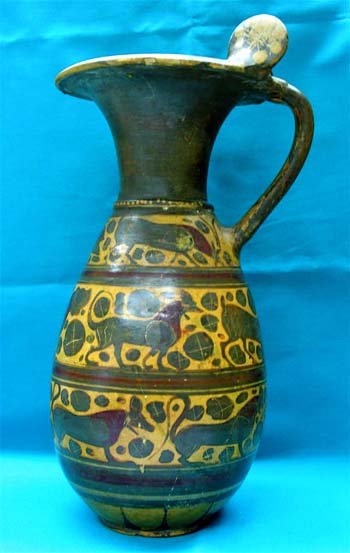
Italy, between 600-575 BCE
(HFMA# 2004.069.007, gift of James and Aneta McIntyre)
Etrusco-Corinthian was a universal Etruscan style of pottery, imitating and adapting the Transitional and Ripe Corinthian style (in the black-figure technique) between 630 and about 540 B.C.E., with its main centers of production located at Vulci, Caere, and Tarquinia. Some characteristic features of the Etrusco-Corinthian style are the grotesquely proportioned animal figures with shoulder markings converted into meaningless circles.
This pear-shaped wine pitcher (olpe) is an example of one of the most popular shapes with typical animal-style decoration in three registers, executed in a dark brown to red brown slip with added red and white paint, as well as incised details. The "Orientalizing" decorative elements include rays, bands, rosettes and "blob-rosettes," dogs, boars, goats, a goose, and a panther. -
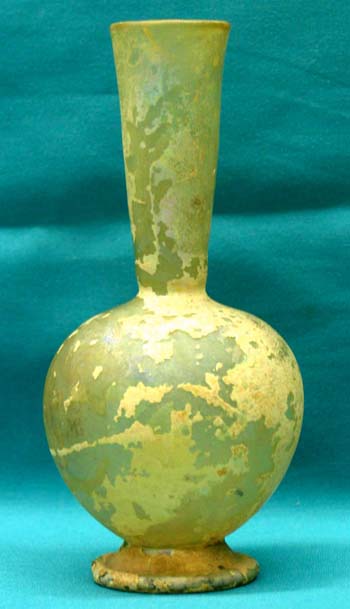
Italy or Near East, 1st - 5th century C.E.
(HFMA# 2004.069.009, gift of Elke and Richard Brockway)
A beautiful example of ancient glass, which is currently identified as Roman (circa first to third century C.E.), but which may be early Byzantine, circa late fifth century C.E. It is a globular flask with a funnel neck, and a base consisting of a folded, stemmed foot (which appears to contain a lead ring)--a probable indication of a later date. -
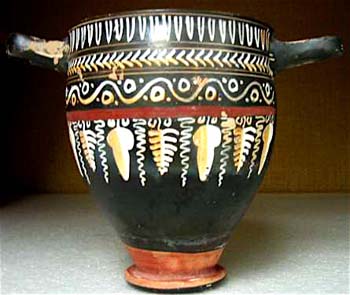
Italy, ca. 310-300 BCE, Middle Gnathia style (attributed to the Knudsen Group)
(HFMA# 2003.060, gift of Elke and Richard Brockway)
This Corinthian-type skyphos is a particularly nice and well-preserved example of a typical drinking cup from Southern Italy in the highly decorative Gnathian style. Decorated with geometric and floral motifs on a black background, this style is characteristic for vases that were produced around the area of Gnathia (today Egnazia) in Apulia, Southern Italy, during the late fourth to the early third century. The decoration on the front side includes a highly stylized vine pattern consisting of grapes, leaves, and tendrils. The back side features a simple band of ivy. The shape is suitable for the symposium or drinking party, and the motifs are not only reminiscent of Dionysos, but also the way that garlands were actually suspended at the symposium. -
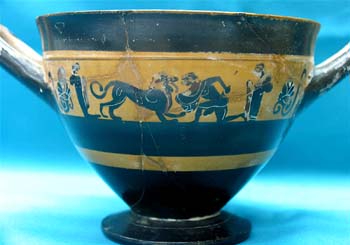
Greece, ca. 530 BCE, attributed to Hermogenes
(HFMA# 2004.069.007, gift of James and Aneta McIntyre)
This drinking cup has the characteristic shape of a so-called skyphos, with a deep bowl tapering at the foot, a low flaring foot, and an offset lip. The particular shape of this skyphos, with the two handles attached at the middle of the bowl, is characteristic for the Athenian potter Hermogenes.The cup's lip is covered by black slip, as is the body, except for two reserved bands. The figural decoration is limited to the handle zone and consists of two virtually identical scenes (front and back), flanked by palmettes growing from the handles. The figural scenes consist of the Greek hero Herakles, nude, with a chlamys (cloak) draped over one arm to serve as a kind of shield, attacking the lion that approaches with mouth open and tongue unfurled. Herakles holds a club in one hand, pulled back behind his body, ready to bludgeon the animal. Standing figures in himatia flank the scene on either side. Three seem to be male and one might be female, but it is hard to be certain. Details are incised and there is some added red dish-purple paint, but the style is not refined.
-
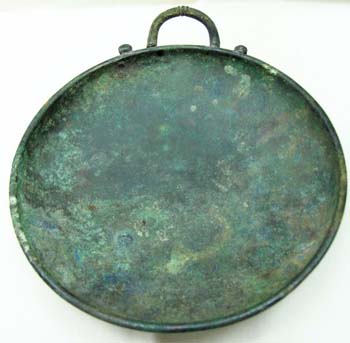
Italy, 1st - 2nd century C.E. (?)
(HFMA# 2004.069.010, gift of James and Aneta McIntyre)
These shallow bowls were used to pour libations, sacrifices of wine or other liquids.
This remarkably well-preserved bronze patera (or offering dish), probably Roman, features a shallow concave bowl with a square lip, a ring base (with a central raised disc and three concentric rings), and a single vertical handle (with three central ridges and ends curled and soldered with lead to the bowl). -
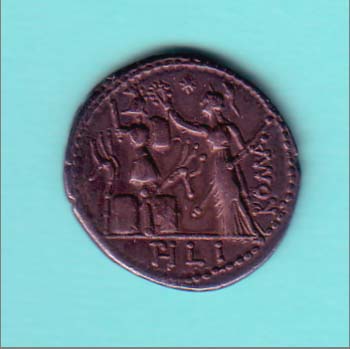
Roman Republic, 119 BCE
(HFMA# 2006.010.070, gift of James and Aneta McIntyre)
Reverse of a Roman silver denarius minted in commemoration of the victory of Gnaeus Domitius Ahenobarbus and Quintus Fabius Maximus Allobrogicus over the Gallic Allobroges and Averni in 121 BCE.
Instead of the usual victory goddess, a helmeted Roma, identified by the inscription, holds a scepter in her left while crowing a trophy with her right. The trophy consists of Gallic arms, as marked by the bear head helmet on top and the two Celtic signal horns (carnyces) left and right of it. The mint master, a Marcus Furius Philus, son of Lucius, is identified by the abbreviated PHILI in the exergue.
The obverse (depicted below) shows a double-headed, bearded Janus head (the doors of the Janus temple were closed when Rome was at peace) and the inscription M. FOVRI. L. F, i.e. M. Furi(us) L(ucii) F(ilius). The coin is part of the James and Aneta McIntyre Collection of Greek and Roman Coins that is currently being prepared for exhibition.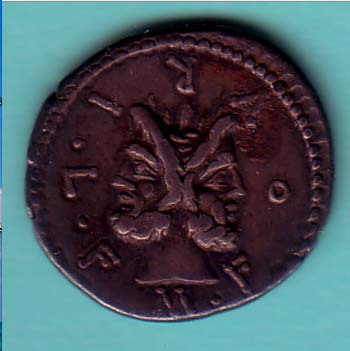
-
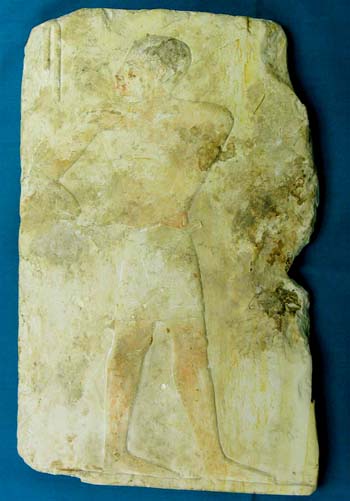
Egypt, probably Old Kingdom, 5th or 6th dynasty (2498-2183 BCE)
(HFMA# 2004.069.001, gift of James and Aneta McIntyre)
This beautiful fragment of a painted limestone relief, probably from the Old Kingdom period, shows a male Egyptian servant and the hieroglyph for "s" in the upper left corner. -
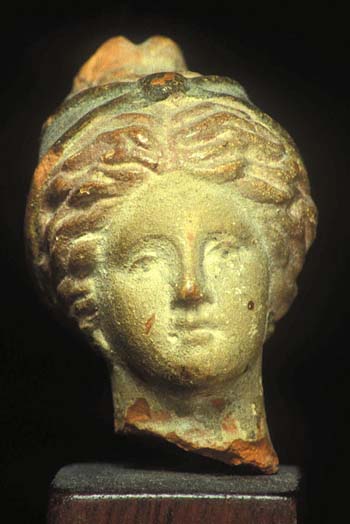
Hellenistic Greece, 2nd century BCE
(HFMA# SPG90.22, gift of Mark and Janeth Hogue Sponenburgh)
This finely molded head, probably broken off from a small statue of a standing Greek woman, is a prime example of the realistic, mold-cast terra cotta figurines of beautiful young women that were first discovered in 1873 in the necropolis of the small city of Tanagra in Boeotia. They became immediately popular with 19th-century collectors. In fact, some 10,000 graves were plundered to satisfy the great demand, and later excavations found that virtually all Hellenistic graves in the area had been robbed.Tanagra figurines were produced both in Tanagra itself and in many other cities around the Mediterranean, such as Athens, Myrrina, and Alexandria. They served as votive gifts in temples and may have decorated upper-class houses as well. They were also popular grave goods for children and women, but only a minority of graves (4% in the necropolis of Tarent in Southern Italy) contain them.
Our example represents a young woman who wears her hair parted and drawn back in regular waves with a bun at the back in a so-called melon-coiffure; the jewel-decorated headband that she uses to tie her hair back is called a sphendone ("sling").Literature:
Higgins, R. Tanagra and the Figurines. Princeton: Princeton University Press, 1987.
Kriseleit, I./Zimmer, G./Eule, J. C. , Bürgerwelten, Hellenistische Tonfiguren und Nachschöpfungen im 19. Jh. Mainz: von Zabern, 1994.
Johnson, D.M., ed., Ancient Greek Dress. Chicago: Argonaut, 1964.